S M B O measurement-vertical measurement-vertical

Latest Stories, Barcelona

La Barraqueta-Resolís

El Resolís has already been through several reincarnations, each time as a meeting place for strong, yet completely different – sometimes opposing – social groups. But even across time, changing styles and menu updates and under different owners and chefs, the place has never altered its name or its basic culinary M.O.: traditional, populist, affordable. Located in the heart of the gypsy Gràcia district, El Resolís was founded in the late 19th century. During the second half of the 20th century, it became the headquarters and the social meeting point for the Falange, the fascist and sole legal party of the Francoist dictatorship. This extremely conservative regime repressed the official use of Catalan and other cultural expressions in Catalonia and other Spanish regions.

Can Vilaró

With all the talk about the benefits of quinoa, chia seeds, goji berries and similar superfoods, we can’t help but be a little taken aback when Dolors, one of the owners of the restaurant Can Vilaró, explains the benefits of eating cap i pota, a traditional Catalan stew made with calf’s head and leg and chickpeas. According to her, the gelatinous chunks of meat make the skin glow and fight wrinkles. “It works as well as the most expensive collagen facial cream available at stores,” she says with a cheeky smile.

CB on the Road

“In Cadaqués, we cure anchovies differently than anywhere else,” Rafel Martín Faixó told us. We were sitting at long wooden tables outside of his family’s winery, on a sunbaked hilltop in Cadaqués, two and a half hours north of Barcelona. Rafel is the son of Carmen Faixó and Rafa Martín Mota, and together with his sisters Ester and Georgina, the five of them comprise the Martín Faixó (MF family) brand, featuring three restaurants in Cadaqués and the Celler Martín Faixó winery, with a rural tourism guesthouse on-site.

Entrepanes Díaz

Kim Díaz, a well-known local restaurateur and owner of Bar Mut tapas bar and El Mutis cocktail bar, wanted to pay tribute to one of the most humble and sadly underrated Spanish snacks, the sandwich. Sandwiches are generally made by most Barcelonan bars with defrosted cheap bread and greasy fillings, and good ones are not easy to find in the city (though we have written about some great ones). Entrepanes Díaz opened last February with the goal of giving the sandwich the respect it deserves.

Norte

On a beautiful corner of L’Eixample sits Norte, a small yet warm, inviting and light-filled bar with a constellation of shining lights spelling out its name inside and a few tables with fresh flowers. The restaurant was started by three partners, Lara Zaballa, María González and Fernando Martínez-Conde (who left the project last year). They met while working at Barcelona’s acclaimed Moo restaurant and had come to cooking from studying philosophy, art history and journalism at university. They were each looking for something more hands-on, work that gave them direct physical contact with matter, and that shared motivation connected them from the beginning. All three also came to Barcelona from other cities in northern Spain. After their experience at Moo and other projects (Zaballa and Martínez-Conde wrote for the prestigious cooking magazine Apicius), they looked for a more enjoyable and less stressful way to do what they loved, starting with basically nothing but their enthusiasm and their solid ideas to convince the banks to give them a loan to start their own restaurant in 2011.

Els Tres Porquets

Marc Cuenca was the kind of kid who was interested in what other people were eating, and this curiosity was the seed of his own restaurant, Els Tres Porquets ("Three Little Pigs"). A small enoteca and tapas bar with just a few tables, it sits in Poble Nou-El Clot, an area that brings to the restaurant a combination of locals, office workers and Spaniards and foreigners employed by startups and other businesses in the 22@ innovation district. While these days the city – and indeed many cities around the world – is teeming with restaurants specializing in an ambitious menu of small plates intended for sharing, in 2009, the concept was still quite new when the "three little pigs" arrived in the city.

Best Buzz

As we wrote in part one, specialty coffee has really taken off in Barcelona, after a long period of limited options and mediocre to bad beans and roasts. Here are a few more of our favorites among the new generation of coffee shops: True Artisan Café Elisabet Sereno, a Barcelonan nutritionist, coffee specialist, a founder of the Specialty Coffee Association of Europe (SCAE) and a judge in the World Barista Championship, opened this coffee shop in 2014. It was created as a showroom and also serves an educational role in improving specialty coffee culture in Barcelona and Spain by organizing events, demos and tastings. True Artisan is an official La Marzocco espresso coffee machine distributor showroom, an SCAE-certified training center and a comfortable bar to while away an afternoon diving into Arabica aromas, latte art, cups, gadgets and machines.

Best Buzz

In Spain, as in the U.S. and elsewhere – even as we hit coffee pod peak – a new multicultural generation of specialty coffee shops are discovering and sharing with their customers the best ways to experience all the special characteristics of truly great coffee. Spain’s cities share the urban Mediterranean tradition of strong short coffee, very much influenced by Italian espresso and served in small cups or glasses, with tons of sugar and perhaps also liquors (orujo or aguardiente, anís, coñac). Much of the time, the quality of this coffee could really hurt your body and soul. It’s made from cheap, low-quality Robusta beans that undergo torrefacto (toasted at 200 degrees C with sugar) – once a technique to keep flavor and increase weight but now widely regarded as a way to hide terrible qualities or to ruin any coffee. At the same time, in the countryside and in small villages, café de puchero, coffee made in a pot and filtered with a cloth, much lighter and more diluted than espresso, was always the brewing method of choice before the rise of the stovetop moka pot.

Pintxos

Oriol’s face lights up whenever a customer selects his favorite pintxo from one of the 49 different trays, beautifully displayed at Euskal Etxea, the bar where he works and the first bar in Barcelona to serve traditional Basque pintxos. One wonders how a small slice of bread topped with a chickpea fritter, jamón serrano and romesco sauce spiked with a toothpick that costs just €1.95 can make someone so happy. We try one and we immediately see why.

Country Dining

As in many other rural parts of Europe, the Catalonian countryside is dotted with large, old farmhouses, legacies of feudalism that have since been converted into hotels, bed-and-breakfasts and restaurants. The origins of these masías, as they’re known in Catalan, go back to the 11th century, but it was not until the end of feudalism in the 16th century that the former serfs turned masías into their own self-run farm holdings and homes. The buildings that survive today may be of a more recent vintage, built perhaps a century ago, sometimes older. Masías were usually named after the family who owned them; “Can Josep,” for example, means “house of Josep.”

Els Encants

Els Encants is the kind of magical, exciting market where we arrive having in mind exactly what we need, but after a few hours immersed among objects and voices, we emerge with a bag full of items we never knew we needed or that we could even find.

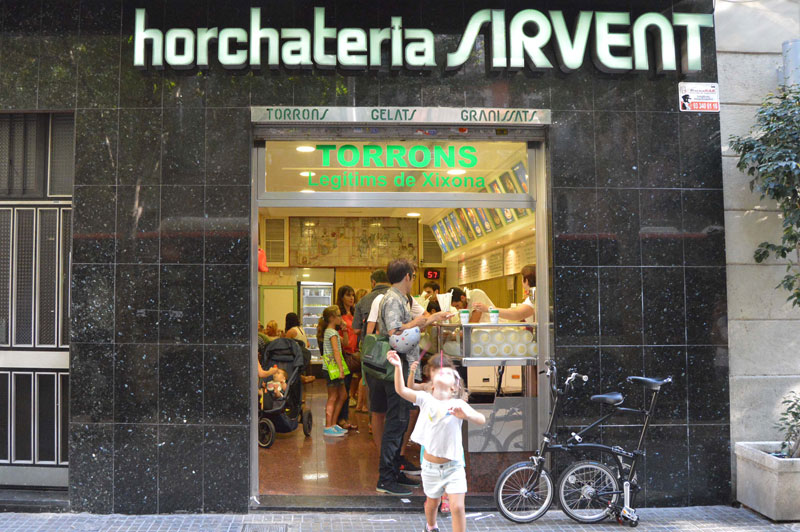
Sirvent, photo by Paula Mourenza

As you might expect from a city whose weather forecast tends to be sunny, Barcelona has plenty of excellent ice cream options, even as summer fades into fall. And, sure, like most of the world’s food-loving metropolises, this town has its share of internationally loved, Italian-style gelaterias – many even run by real, live Italians.

Mercat del Ninot

El Mercat del Ninot opened way back in 1894, but recent renovations have breathed new life into this L’Eixample market. From time to time, the local government has updated noucentistes (19th-century) municipal markets in Barcelona, keeping the essence of the buildings but bringing them up to speed with current needs and trends. The Mercat de la Llibertat in Gràcia and Mercat de Santa Caterina in Born have received their facelifts, and the amazing Mercat de Sant Antoni is expected to open in 2016 after more than six years of construction.

CB on the Road

Upon the hot and dry plains of Les Garrigues, two irrigation canals cut through an agricultural expanse, diverging first from the ample Segre River, which runs through the center of the city of Lleida, before subdividing again, their meandering channels reaching farther and farther into an otherwise parched plateau. These life-giving tributaries are collectively known as the Canal d’Urgell. Les Garrigues, a region of the Catalan province of Lleida, is a fertile green splotch on an otherwise arid landscape 150 kilometers inland from Barcelona. The irrigation of this region, first conceptualized by the Moors in the 13th century but carried out on a grand scale in the late 1700s, has enabled the cultivation and nurturing of farmland, where a crop of prized arbequina olives and fragrant almond trees now stretches toward the horizon.

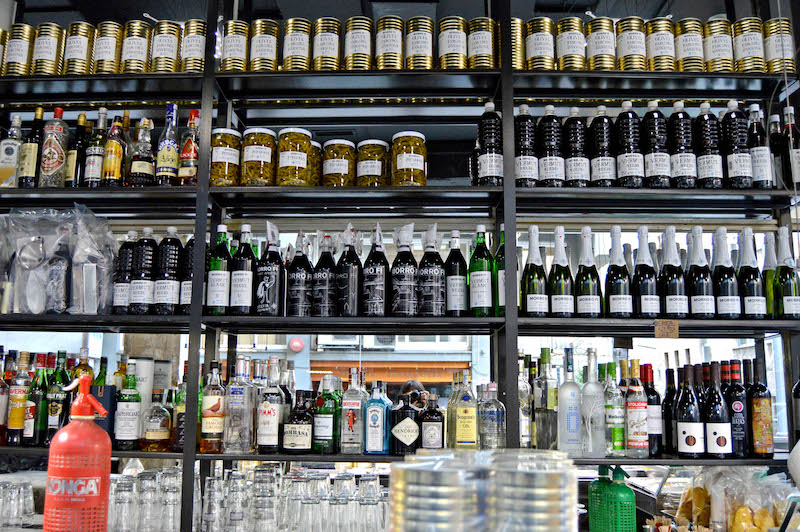
Morro Fi's vermouths and preserved foods, photo by Paula Mourenza

Why are you seeing colorful, 1960s-era carbonated water siphons everywhere in Barcelona? Because they’re the symbol of our beloved vermut ritual. The phrase hacer el vermut (literally “to do the vermouth”) in Spain has for decades described not only that delicious beverage, but also any kind of pre-lunch aperitif. But since the end of the 19th century in Barcelona, the vermut ritual – a fresh drink accompanied by tapas composed usually of preserved food, cold cuts, cured or marinated fish or seafood – has been a way to bring people together before meals. Perhaps no one is more responsible for vermouth’s popularity here than Flaminio Mezzalama, the Italian Martini & Rossi representative in Spain, who in the first decade of the 20th century opened two beautiful Art Nouveau vermouth bars, which became hugely popular. Mezzalama died in Torino in 1911, but the fame of vermouth in Catalonia only grew, with local investors putting their money into production of Catalan vermut.

logo

Terms of Service