S M B O measurement-vertical measurement-vertical

Latest Stories, Barcelona

Barcelona's Gintonics

Editor's note: Our third installment in the Global Bar Crawl takes us to Barcelona, where gin continues to be the drink of choice among locals. Tomorrow we head to a spot in Istanbul where you can spend an evening visiting a number of bars, all without leaving the building. Spain is a country that loves a long-drink – alcohol in combination with a soft drink, refreshing and open to invention and reinvention. On the heels of creative gastronomy’s efflorescence in recent years, many old drinks, cuisines and forgotten ingredients have returned, revived through new and more sophisticated techniques and interpretations. The gin and tonic, called gintonic here, is one such Spanish obsession, and all that ingenuity and focus have gone into taking this highball to the next level.

Cua Curta

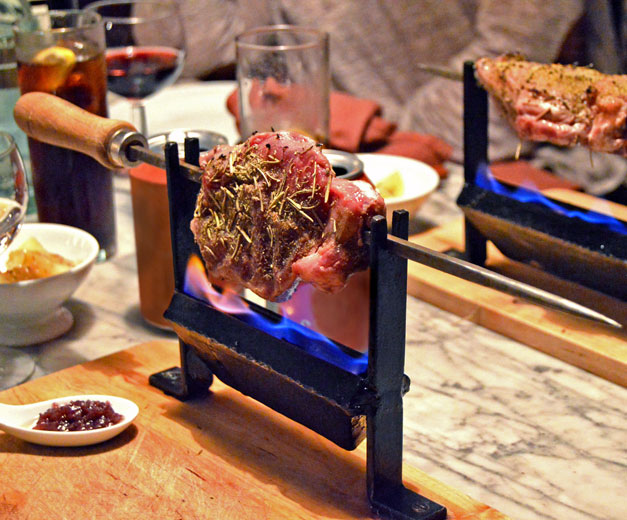
Deep in the heart of El Born lies a medieval labyrinth of dark stone buildings and massive wooden doors, scant light, narrow passageways and dozens of colorful little shops, ateliers and hidden bars and restaurants. Of the last, La Cua Curta is one of our favorites, a family restaurant specializing in cheese fondue, unusual salads, carpaccios of meat and fish, homemade pâtés and a remarkable veal steak.

Morro Fi and Mitja Vida

Morro Fi and Mitja Vida are two relatively new entrants to Barcelona’s vermuteo (“vermouthing”) culture, whose history stretches back to the turn of the last century. These two bars are the product of nostalgia for a bygone era fused with the social network- and urban design-driven present. The vermouth tradition in Barcelona was started in the early 20th century by Flaminio Mezzalama, who represented the Italian company Martini & Rossi in Spain, at his fabulous modernist Bar Torino. Vermut began to be produced in Catalonia, and in the following decades, the province developed its own style of the aromatic fortified drink. At the same time, the custom arose of having vermut before lunch with some pickles to whet one’s appetite. That tradition faded over time but has emerged in recent years as a kind of retro, hipster-approved pastime.

Ask CB

Dear Culinary Backstreets,We are traveling with a group of friends to Barcelona. A few of us are vegetarians, and we all love good food. I know Barcelona is a meat – and particularly pork – lover’s paradise, but can you recommend any vegetarian-friendly restaurants? Is it possible to enjoy tapas and Spanish cuisine without meat or fish?

La Portería

Editor’s note: We regret to report that La Portería has closed. Looks can be deceiving. A case in point: La Portería appears dull at first glance, but venture down the few steps that separate this singular restaurant from the street’s frivolity and you will be rewarded.

Can Ros

Fried pig’s ears fortified with garlic and parsley, veal cheek and tongue laced with vinaigrette, hefty veal and pork meatballs, creamy artichoke or eggplant omelets or a hearty bocadillo of marinated tuna, red pepper, anchovies and olives: these esmorzars de forquilla, or “fork breakfasts,” are how a Catalonian might start his day – especially at Can Ros, a tapas-and-bocadillos joint that’s open every day from 7 a.m. until midnight. Office workers might drop by for a coffee at mid-morning, followed by the lunch crowd, which takes over from 2 p.m. to 4 p.m. Dinner, of course, lasts well into the night. It’s breakfast, however, that has made Can Ros most popular among locals.

El Passadís del Pep

A hidden culinary sanctuary, El Passadís del Pep may be located in one of the most visited quarters of Barcelona, but it’s out of sight of anyone who isn’t looking for it. Once you go down the long corridor that leads to the restaurant, you don’t need to do anything, and that includes choosing what to eat. From the moment you sit down, the “house” offers you your first bottle of cava, and the celebration of food and life begins. There is no menu and there are no “daily specials,” just whatever Joan Manubens and his team decide to cook that day.

Baluard bakery, photo by Paula Mourenza

Editor’s note: This post is the second installment of “Best Bites of 2013,” a roundup of our top culinary experiences over the last year. Stay tuned for “Best Bites” from all of the cities Culinary Backstreets covers. Forn Baluard We started the year off heating our hands near the wood-fired oven at Forn Baluard, one of Barcelona’s top bakeries. It hasn’t been around long, but it has decades of experience in its DNA, as it’s headed up by Anna Bellsolà, a fourth-generation baker.

El Tossal

Now that ski season has begun in Catalonia, thousands of Barcelonans make the pilgrimage every weekend to the Pyrenees. But winter sports are not the only draw; this is also the time to enjoy the cooking at masias, traditional farm buildings that have been converted into restaurants.There, the smells of winter stews and dishes made with mushrooms, game, mongetes (beans) and butifarra (a kind of pork sausage) are motivation enough to arrive at the village early and in one piece.

Catalonia's White Wines

When we think of white wine in Catalonia, we think of its seemingly endless possibilities. Production of whites here has a 2,000-year-old history. The wide-ranging diversity in the area’s Mediterranean climate and calcareous soils, from the mountains to the sea, and the combination of old grape varieties and newly introduced “foreigners” with traditional and experimental methods of production make for innumerable styles and no taboos. Who knew white was a color with so many variations? The traditional Catalan grape varieties used to make white wine are mainly macabeo, xarel-lo, parellada and garnatxa blanca, but this area of Spain has the largest number of white grapes included in all its protected appellations (D.O.). Where other Spanish D.O.s usually are deeply defined by one or a few varieties, in the Catalunya D.O. there are more than 16 allowed – 35 counting the reds. In fact, this umbrella appellation, which covers wines that do not fall under the 10 subregion designations (Montsant, Penedès, etc.), was created to allow the use of all the grapes of the other Catalan designations in the entire area. It implicitly gives freedom to Catalan winemakers to express more than the old narrower conceptions of terroir and opens the doors to experimentation.

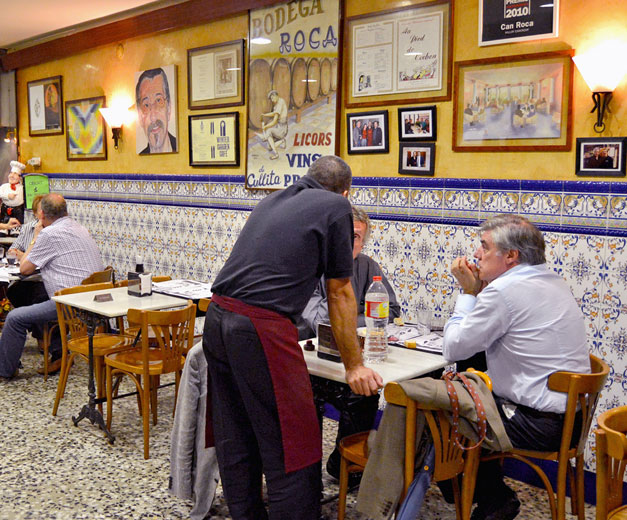
Taverna Can Roca

Editor’s note: We regret to report that Taverna Can Roca has closed. In the neighborhood of Sant Andreu we encounter very few city visitors wandering the cobbled streets or peering at the 19th-century two-story houses that pepper this district. Through the doors of Taverna Can Roca, we find even fewer. This is a place that can be considered muy del barrio.

La Pepita

We’ve written a great deal about all thetraditionalCatalan, Basque and Spanish food around town, but what about the modern, globally influenced cooking that’s taken hold in the food capitals of the world – of which Barcelona is certainly one? La Pepita is a prime specimen, with its passionate, creative young owners and food that, while anchored in the tapas tradition, reinterprets classic dishes through the cross-pollination of other cultures’ ingredients and ideas.

Capped

Mushroom hunting has an irresistible, magical pull. Composer John Cage, an avid mushroom collector, found them an integral part of his creative process, once writing: “Much can be learned about music by devoting oneself to the mushroom.” Every fall, thousands of Catalans likewise find themselves under the mushroom’s spell, following the elusive fungus’s silent melody into the woods, a rustic wicker basket in one hand and – more and more these days – a GPS-enabled smartphone in the other.

Bodega Manolo

At first glance, Bodega Manolo seems like the usual wine shop/tapas bar that Barcelona does so well: a solid place to replenish our wine stocks from the barrels, quench our thirst with a cold caña or satisfy our hunger pangs with a vermut and a tapa or two of oil-drenched anchovies. None of which sound too shabby. However, we know to venture through to the rear, where, at dinnertime, the brilliant white tablecloths reveal the venue’s greater ambitions.

La Perla de Oro

Anouchka hails from Extremadura, land of jamón and some of Spain’s best dry-cured sausages. Julien is French and an expert on wine. Together, the husband and wife run La Perla de Oro (“The Gold Pearl”), a pint-sized former colmado (old-style grocery) just off Las Ramblas, where top-notch bocadillos, or baguette sandwiches, are just one of many attractions. Since opening in 1939, three generations at La Perla have supplied their Raval neighbors with cured sausages, cheeses, preserved foods, salted fish and dried legumes. They became known especially for their bocadillos.

logo

Terms of Service