S M B O measurement-vertical measurement-vertical

Latest Stories, Barcelona

Turrón Time

A vendor weighs Marcona almonds that will be used to make turrón, a delicate type of soft nougat with ancient culinary roots. It is one of Spain’s most popular Christmas treats.

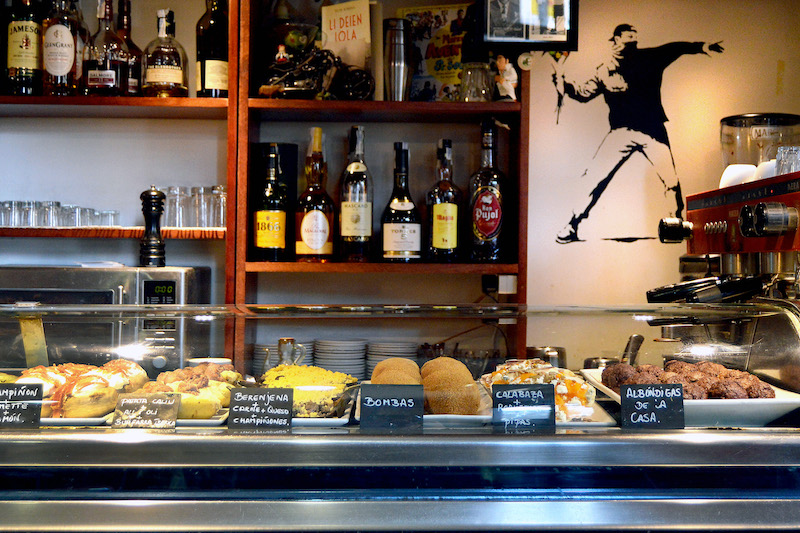
The tapas selection at Bodega Bartolí, photo by Paula Mourenza

Bodega Bartolí opened in 1939 as a little bulk wine shop in Barcelona’s Sants neighborhood. Then everything changed for the bodega some 20 years later when a local client arrived with a stomachache. He asked a young Marina Dolz, who was minding the wine shop with her husband, if she could prepare some soup for him. It was the first dish she cooked there and, since then, Bodega Bartolí has moved far beyond simply being a wine store. At the time Bodega Bartolí opened, Sants was still an industrial quarter with several factories and thousands of workers. During the 1940s, the bodega sold both bulk wine to the neighbors and factory employees and barreja (a very traditional drink made of Muscat wine and anise liquor) to the wheelwrights passed by everyday.

The counter at Bar Ramón, photo by Paula Mourenza

It’s not too often that you find a restaurant in Barcelona where rock & roll, blues and jazz are some of the main ingredients. But that’s just the case at Bar Ramón, an iconic restaurant and tapas bar in Sant Antoni. Mediterranean grilled red prawns, patatas bravas, and xipirones (baby squids) a la Andaluza (coated in batter and fried) are carried from the kitchen to the table under the watchful eyes of Charlie Parker and Muddy Waters, who look down from posters on the wall. Also on the wall, sharing space with the standard FC Barcelona crest and a photo of a castell (Catalan human tower) in front of the old Sant Antoni Market, is Bo Diddley’s guitar.

Some of the ingredients that go into making ratafia at the Ratafia Festival, photo by Sam Zucker

In the little town of Santa Coloma de Farners, within the Catalan province of Girona, locals have been making the herb-infused liqueur known as ratafia for centuries, with each family passing down their own version of this unique libation from one generation to the next. In 1997, within the county’s official records, came a major food discovery – written recipes for three distinct styles of ratafia dating back to 1842, which are now recognized as the oldest of their kind in Catalonia. These handwritten lists of ingredients (along with other culinary notations, savory recipes and home remedies) were discovered in the old notebooks of Francesc Rosquellas, once the proprietor of a café/restaurant in Santa Coloma de Farners whose name had long since been forgotten.

Clams at Bodega Neus, photo by Paula Mourenza

Bodega Neus, a tranquil, cozy spot on a narrow street in Gràcia, may look like a regular old bodega-restaurant. But this place, which is celebrating its centennial in 2017, merges two culinary traditions with deep roots in Barcelona: wine and seafood. In the beginning, Bodega Neus was a bulk wine-shop. Over the decades, it morphed into a bar and then a restaurant; during the course of it’s 100-year history, it was owned only by two families, both of which respected the spirit of the bodega and the traditional recipes that anchored the menu.

Barcelona Post-Referendum

I used to joke that the only thing binding together Spain is the classic tortilla española, which in Catalonia we refer to as the tortilla de patatas – a neutral name. This potato omelet is one of the very few traditional dishes that is prepared the same way (and equally beloved) throughout Spain’s Autonomous Communities, the regions created after the Spanish Constitution of 1978, a necessary step towards creating a democratic country after the end of Franco’s dictatorship. The fact that this is one of the few dishes we all have in common highlights the significant regional differences of our traditional cuisine, despite our common Mediterranean culinary culture.

Bubbling Over

Bar chats are on fire these days in Barcelona. As the controversial Catalan independence referendum draws closer, it’s not uncommon to witness spontaneous private discussions or overhear customers express passionate or indignant comments while reading the newspaper or watching the news on the bar’s TV. There is tension in the air, and bars, perennially popular agoras for debate, have become even livelier places. Many Catalans, whether pro-independence or not, will find themselves voting under difficult conditions on Sunday, October 1, in the controversial referendum organized by the Catalan government.

Barcelona’s Healing Outdoors

After last week’s horrific terror attack, Barcelona’s Las Ramblas are back to life: candles, flowers and messages written on any available surface share the place with a dense river of humanity walking along the boulevard or having a coffee in one of its terraces. Instead of giving in to fear or hate, Barcelonans have made a defiant show of sticking to their summer routine of going out and taking advantage of their city’s abundant outdoor spaces, turning them into places of healing. With this response in mind, we dedicate our guide to outdoor dining in Barcelona to the victims of last week’s attack and to the multitudes of people that, in all their cultural diversity, always were and will be the peaceful essence of Las Ramblas de Barcelona.

The open kitchen at Carballeira, photo by Paula Mourenza

The Spanish Civil War may have ended five years earlier, but in 1944 Barcelona was still recovering from the conflict. Franco’s budding dictatorship had put in place a complicated social and economic situation, while the city’s port – home to a humming underground black market – was rebuilding its fishing fleet, as fascist bombs had destroyed most of the boats during the war. Amidst all this action and uncertainty, the Galician Millán family opened a restaurant named Carballeira on Reina Cristina Street, in the Pas de Sota Muralla neighborhood of Port Vell (Old Port). Fisherman and port workers flocked to the restaurant, where over fish soup, grilled sardines, prawns or a bowl of hearty Galician Caldo Gallego – and almost certainly a glass of wine – they talked about the situation.

La Mundana

Sants is a working neighborhood with an industrial past and a communal present, both of which it proudly flaunts. There are the street names – like L’Espanya Industrial, Carrer Wat (dedicated to the engineer James Watt) and Vapor Vell (Old Steam) – that tell the story of industrialization in Catalonia, and the two buzzing municipal markets and the many bodegas and restaurants, like Terra de Escudella or Bodega Salvat, that serve as meeting points for an engaged community. Although shaped by a diverse set of international influences, the neighborhood’s sophisticated culinary scene is tied together by something more local: vermut culture.

Unsung Heroes

One of the tenets of the Slow Food movement is that it’s impossible to make a really good meal out of industrial food. Of course certain ingredients can pass muster with diners even if they’re grown on an industrial farm. Yet sustainable farming has an obvious impact – it’s not just a matter of better tasting and healthier food but also environmental and societal benefits. In Barcelona, we are surrounded by a large number of independent, sustainable producers that, too often, are completely invisible. They work in nearby provincial areas such as El Prat, El Penedès, El Vallès, El Garraf and El Maresme that give forth a veritable cornucopia of food goods: vegetables, fruits, nuts, legumes, olive oil, cheese, marmalades, cereals, flours, honey, meat, fish, wine, vermut, beer and more. These producers work hard every day to remain independent and adhere to stringent standards of sustainability and quality.

Moving Fast

The Slow Food movement may be all about slow living, but its spread around the world has been nothing short of speedy. What began as a protest against the opening of a McDonald’s in the Piazza di Spagna in Rome in 1986 has morphed into an international organization that safeguards some of the most authentic and unique local food products in 160 countries across the world, and even receives UN recognition and support for this important work. In Spain, the Slow Food movement mainly consists of independent regional groups made up of chefs, producers and other food-related professionals, and its influence continues to grow as new initiatives are gradually launched.

Revetlla de Sant Joan

On the night of June 22, a fire is lit at the top of Canigó mountain in the Pyrenees. All through the night, hundreds of volunteer torchbearers carry the flame to towns and villages throughout the four provinces of Catalonia. The arrival of the flame the next day signals the start of the Revetlla de Sant Joan (St. John’s Eve celebration). Bonfires, firecrackers and fireworks light up the night, and people while away the hours drinking, eating and dancing in public squares and beaches or at parties. Fire, noisemaking and dancing are the main ingredients of St. John’s Eve, the Christian adaptation of ancient pagan celebrations of the summer solstice.

El Racó del Mariner

There are certain places that experience the strange phenomenon where everything and nothing change at the same time. Take the example of El Racó del Mariner (The Sailor’s Corner), located for 40 years at the old fishermen’s dock in the port of La Barceloneta until it was forced to move when the area was turned into a marina for luxury yachts. Regardless, even at its new address in the modern Port Fórum area, reaching El Racó del Mariner requires that you cross a port police checkpoint, just as you had to at the old spot.

El Bisaura

Inside Barcelona’s lesser-known Mercat de Les Corts is a small, unassuming bar offering up the bounty of the Mediterranean. El Bisaura opens up shop at 6:30 a.m., serving esmorzars de forquilla (hearty Catalan breakfasts like sausage and beans, tripe stew and grilled cuttlefish) to local workers. At lunch, it serves a more refined seafood menu composed of whatever owner Alfonso Puig gets from Peixateria Anna, the fish stand on the other side of the market. The fish and seafood of the day are always seasonal, local and impeccably fresh – which is no surprise, since Puig is also the owner of the fish stand.

logo

Terms of Service