S M B O measurement-vertical measurement-vertical

Latest Stories

Mezedes at Seirines, photo by Diana Farr Louis

Editor’s note: We’re celebrating another year of excellent backstreets eating by taking a look back at our favorite restaurants and dishes of 2015. In a country that can boast of very few authentic (if there can be said to be such a thing when it comes to cooking) Greek desserts, galaktoboureko remains quintessentially Greek. This semolina custard pie of cream between layers of thin phyllo doused in syrup remains a firm national favorite. Kosmikon is the undisputed king of Athenian galaktoboureko. An old-fashioned dessert shop operating since 1961, it now has five locations around Athens. The galaktoboureko here is done the traditional way, with butter from Thessaly in central Greece or Mytilene, homemade phyllo and – most importantly – no lemon or orange flavoring, just the traditional vanilla. The result is that rare thing when it comes to phyllo-based, syrup-drenched desserts: a wonderfully balanced concoction, sweet but not too sweet, with cream oozing from the sides, and the phyllo remaining thin and crisp. We recommend going to the two central locations in Agios Nikolaos and Agios Eleftherios for their charmingly retro atmosphere.

La Panxa del Bisbe

Editor’s note: We’re celebrating another year of excellent backstreets eating by taking a look back at our favorite restaurants and dishes of 2015. La Panxa del Bisbe Xavi Codina has created a menu of almost 30 tapas or platillos (small dishes) and four desserts, combining traditional Catalan cuisine with international influences that Codina has encountered in his life or in the neighborhood. Much of the menu changes according to season and customers’ tastes, but there are a few perennial favorites, such as the homey croquettes, with their generous quantity of chicken and carrots; duck liver with pears and wine; and the cap i pota, a traditional dish made from pork trotters and head, which the chef tweaks throughout the year.

A Shan

Editor’s note: To cap off the year, we’re taking a look back at all the best eating experiences we had in 2015, and in Shanghai, that means everything from fried pork buns to shakshuka made with local ingredients. Yang Yang’s Dumplings The chengguan were out in full force shutting down our favorite street food hot spots this year, including one of Shanghai’s most popular night markets on Fangbang Lu and the soon-to-be-closed Tangjiawan market. We’re reminded that it’s ever more important to support those vendors who take pride in their craft and hand-make everything from start to finish.

Best Bites 2015

Editor’s note: Tbilisi was a new addition to Culinary Backstreets this year, and as we look back on all the great eating we did in 2015, we can’t help but notice that so much of it took place in the city's Sololaki area. There’s a typecast in Georgia that when somebody wants to go into business, they open up a khinkali restaurant. There is a logic to that. About a million people live in Tbilisi, a city built impetuously along the hilly banks of the Mtkvari River. And the adoration every single one of these people has for this boiled dumpling is so reverent, it is as if they see Jesus and his disciples feasting on a steaming platter of kalakuri khinkali for the Last Supper as they bite a hole into the dumpling and slurp its tasty broth.

Best Bites 2015

Editor’s note: To give 2015 a proper send-off, we’re taking a look back at all our favorite eating experiences this year. Hamo’nun Yeri The nohut dürüm, a simple wrap of mashed chickpeas, peppers, parsley and spices, may be a popular breakfast choice in certain districts of the southeastern province of Gaziantep, but we'll eat it anytime and are prepared to travel far and wide to do so, as this treat is by no means common in Istanbul. Hamo'nun Yeri is located in Güngören, a densely packed working-class district located well outside the radar of tourists and more affluent Istanbulites. Made with bread hot out of the oven from the family's bakery down the block, the dürüm – and a chat with the friendly Gül brothers – is more than worth the trip. Address: Güngören Merkez Mah., İkbal Sokak 9/B, Köyiçi Telephone: +90 535 016 0316 Hours: 7am-10pm —Paul Osterlund

Best Bites 2015

Editor’s note: As the year comes to a close, we honor some of the people who are keeping up traditions on the Japanese food scene. And we remember the foods we’ve dreamt about eating again and again from each of them. Nodaiwa This 200-year-old restaurant, one of Tokyo’s best sources of wild-caught unagi (freshwater eel), is housed in a building brought from Hida-Takayama in Gifu prefecture, which is famous for gassho-zukuri farmhouse architecture, with its massive dark wooden beams and thatched roofs. The structure was dismantled and then hauled down to Tokyo piece by piece and reassembled in the modern building where Nodaiwa offers a small glimpse of traditional taste and skill, with vintage touches throughout. Fifth-generation chef Kanejiro Kanemoto keeps the tradition alive and deserves his Michelin star. His passion for offering only the best eels available is evident in everything he serves.

Mari

Editor's note: The chef and owners of Mekan have moved on to a new location, which they've named Mari. We're sorry to report that Mekan itself has since gone downhill. In the great multicultural Anatolian kitchen, questions about the ethnic or national origins of foods are often cause for forks and knives to fly. A porridge called keşkek is a hot-button diplomatic issue between Turkey and Armenia, and we won’t even get started on the ongoing baklava debate. So what to make of this cuisine that draws influences from every corner of the former Ottoman lands, a territory stretching from the Balkans to North Africa? The answer might be in a simple term that’s becoming popular among Turkey’s minorities. The word Türkiyeli means “of Turkey” and differs significantly (and quite intentionally) from the word Türk, which often adds ethno-religious shades to nationality.

The Phyllofiles

The subject of frequent arguments over who actually invented it, baklava has a history as multilayered as the flaky dessert itself. The story may actually go all the way back to the 8th century BCE and the Assyrians, who layered bread dough with chopped nuts and honey and baked the result – a kind of proto-baklava – in wood-burning ovens. Perhaps carried by the winds of trade, different versions of this ancient dessert appeared on Greece’s shores a few centuries later. The 3rd-century-CE Deipnosophistae ("Banquet of the Learned") – sometimes referred to as the oldest surviving cookbook – provides the recipe for gastrin, aka Cretan “Glutton Cake,” a sweet that also seems to presage the arrival of baklava as we know it. The instructions, attributed to Chrysippus of Tyana, one of the leading dessert experts of antiquity, calls for turning various chopped nuts, boiled honey and poppy and sesame seeds into a paste which is then spread between two sheets of thin, rectangular dough. At a certain point, ancient Greek cooks started using thinner sheets of pastry, better known as phyllo – Greek for “leaf” – getting closer to today’s baklava.

Commune 246

National Route 246 is one of Japan’s main byways, stretching for over 76 miles and snaking through the center of Tokyo. The small part of Route 246 that runs between Shibuya and the Meijii Jingu Shrine was recently recreated for one of the best-selling video games of all time, Gran Turismo 3: A-Spec. It also happens to be the location for the food court heaven known as Commune 246.

CB on the Road

On the western coast of Turkey, the town of Alaçatı sways to the light of a thousand glowing cafés. What was once a typically beautiful and sleepy Turkish fishing village has transformed into a hub for glitzy nightlife. People swarm the seaside walkways to see and be seen, arriving in metallic SUVs and humming Italian land rockets. Throngs of bejeweled summer vacationers stream through picture-book cobbled streets and whitewashed roads, but if you can break through the crowds, a fantastic meal awaits. Babushka Restaurant offers the opposite of what Alaçatı is known for: homey seclusion. Nestled in the walled garden of the chef’s home, restaurant goers are transported away from the hum of Alaçatı to the peace of their grandmother’s backyard.

Toros

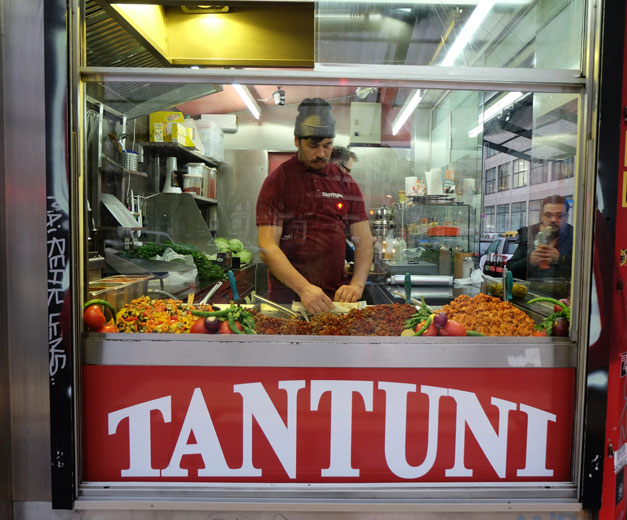
In Berlin, there is no shortage of meatless options, and vegetarians can even rejoice in a seitan-based döner kebab that is given the proper spit roast. What did surprise us is that the ubiquity of vegetarian diets in the city has greatly impacted one version of a meat-centric Turkish street food classic. Toros Tantuni is a small stand that occupies a rather lonely corner of the central part of the Kreuzberg district, a place once inhabited by a ragtag mix of immigrants, squatters and activists, ignored by most Berliners who could afford to live elsewhere. In recent years, however, the area has been thoroughly spritzed with the essence of gentrification and has a flood of innumerable bars, coffee shops and boutiques.

Las Delicias

Manolo, the protagonist of Juan Marsé’s 1965 novel, Last Evenings with Teresa, possibly the saddest Spanish love novel ever written, spends a great deal of his time drinking and playing cards with the local elders in Las Delicias. Well known to locals and Marsé’s devotees but unknown to many Barcelonans, this bar was founded in the Carmel neighborhood in the mid-1920s using a natural cave that was turned into a bomb shelter built just below the republican air defenses during the Spanish Civil War (1936-1939). El Carmel, a working-class neighborhood on Rovira hill with spectacular views over the city, was home to the Andalusian, Galician, Aragonese, Castilian and Extremaduran immigrants who moved to Barcelona looking for brighter futures during the postwar years, the 1960s and ’70s. Las Delicias soon became their favorite local eatery, as portions were larger than usual. Decades later, portions are still very generous, the bar is still a neighborhood institution and the menu still reflects the origins of those who once settled down here. There are Andalucian specialties such as calamares a la andaluza (deep-fried squid, €6.50), morcilla de Jaén (pork blood sausage, €1.60) and pincho moruno (marinated chicken on a skewer, €4.50); Galician specialties like pimientos de Padrón (€5.25), lacón con cachelos (boiled pork shank, €7) and pulpo a la gallega (boiled octopus, €13.95); Aragonese longaniza (pork sausage, €5.25) and Castilian callos (beef tripe stew, €5.25).

Fıstık Ahmet’in Yeri

Büyükada has long been a popular destination for İstanbullus seeking a break from harried metropolitan life. With its array of quaint köşkler (Ottoman-era wooden mansions), walkable woods and relative quiet (automobiles are prohibited, so there’s none of the modern world’s ubiquitous, underlying machine hum), this five-square-kilometer island, about an hour’s ferry ride southeast of the city center, serves as a welcome counterpoint to the bustle and bother of existence in an urban agglomeration of 14 million. There’s just one problem: The dining scene is insipid. There’s no shortage of fish restaurants along the esplanade, just east of the ferry terminal, but in our experience they’re undistinguished – indeed, indistinguishable – and maddeningly overpriced: in short, tourist traps. Some of the boutique hotels offer reasonable, if unexciting, fare on-site, but if you want to dine out, that row of uninspired seaside eateries is the only game in town.

Picnic on the rocks -- photo by Jonathan Lewis

Summer months in Istanbul can be oppressively hot. In a city that seems more prone to laying asphalt than planting trees, a public place in the shade is hard to find. Though many Istanbulites escape to the green spaces outside of the city on weekends, we’ve compiled a few inner-city options for the urban picnicker looking for a break from the heat. First you’ll have to assemble the picnic basket. For its bountiful shopping options and convenience, we suggest doing so in the Cihangir neighborhood of Beyoğlu. In addition to a Carrefour supermarket, which is useful for certain picnic essentials, this area also has a few gourmet shops and fruit stands that easily fill the basket.

Erisvaldo's Roscas: Dirty Doughnuts Featured Image

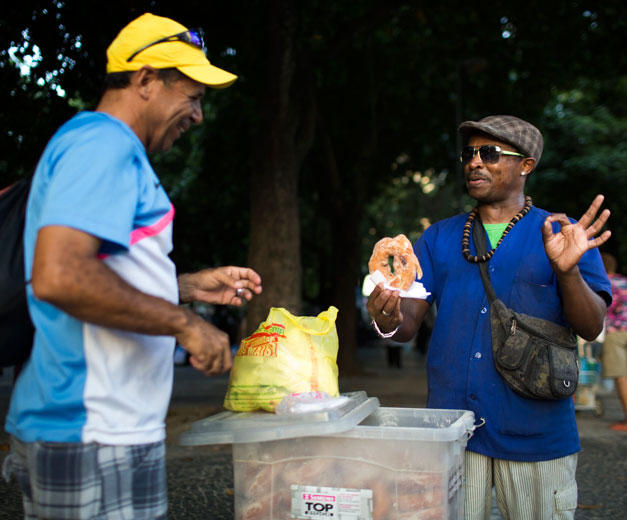
Erisvaldo Correia dos Santos dreamed of being a star. He saw himself as a humorist, a singer maybe, and most certainly an artist. But the scrabbling northeastern immigrant came in 2005 to Rio, the Brazilian city of dreams, with just 20 reais – about $9 – in his pocket and a family to feed. “When I came here, I was hard as a coconut,” dos Santos says, meaning he was hard-up for cash. Nothing a little self-deprecation and naughty jokes couldn’t make up for. Food and guilty pleasure have a long, intertwined history, going all the way back to Adam and Eve. In that vein, snickering Brazilians have long appropriated the verb comer ("to eat") to mean a more carnal type of consumption. Rosca, the word for “screw,” has been turned into something even more blush-worthy, referring to other, fleshier things that can be screwed, and is also used to refer to a nicely round doughnut.

logo

Terms of Service