S M B O measurement-vertical measurement-vertical

Latest Stories

Isabella De Cham Pizza Fritta: Equal Opportunity Pie Featured Image

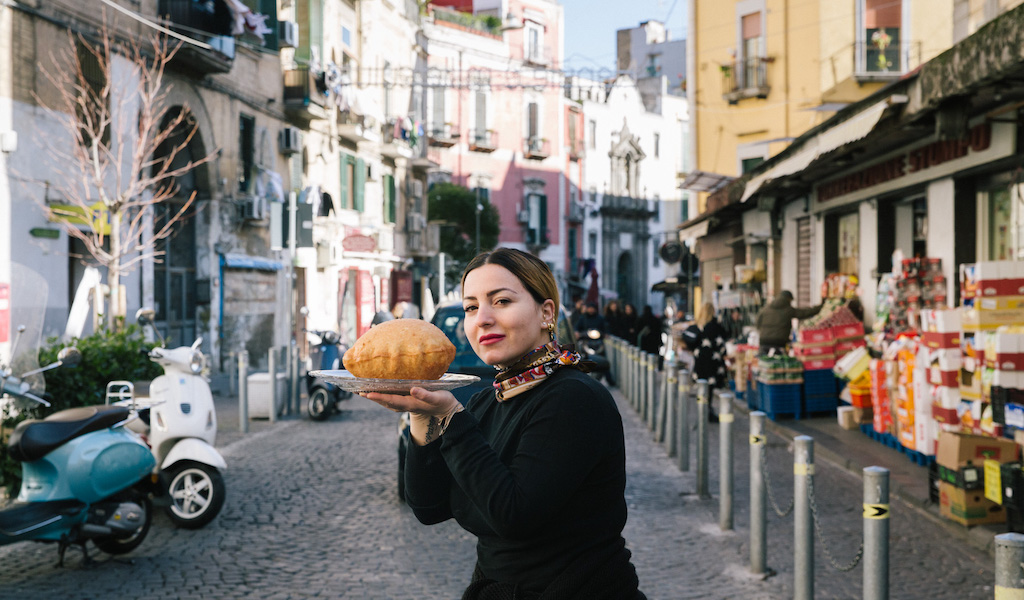
After a morning spent walking around the Fontanelle Cemetery, the oldest ossuary in Naples, and the Sanità market, we believe that we have created enough of a calorie deficit to face a fried pizza – the original pizza, born before the more familiar oven-baked variety, and a universally beloved dish in the Neapolitan cuisine – with self-acquittal. And in the Sanità neighborhood, there’s no question that we’ll be seeking out the fried pizza of Isabella De Cham. The 26-year-old makes creative and high-quality fried foods in an elegant and polished restaurant, with a black-and-white color scheme – not quite what you’d expect for a fried pizza joint, although the familiar warmth is still there.

Tarihi Odabaşı

When a tiny three-table restaurant has but a single item on its nonexistent menu that it has served for nearly three quarters of a century, one steps in the door with high expectations and an enthusiastic appetite. These will be met and exceeded at Tarihi Odabaşı, a hole-in-the-wall in the heart of old Istanbul that has been making çiğ börek – a buoyant, lightly-fried pastry stuffed with ground beef that is a staple of Crimean Tatar cuisine – since 1950. The restaurant gets its name from the nearby Has Odabaşı Behruz Ağa Mosque, built in the 16th century by doyen Ottoman architect Mimar Sinan. It is located in the Çapa/Şehrimini neighborhood, which is inside the old city walls of Istanbul.

Simpang Asia

Leni Kumala and her husband Welly Effendi didn’t plan on opening an Indonesian restaurant when they first came to Los Angeles from their home country. When Simpang Asia first opened in 2002, it was a small grocery store in Palms selling Indonesian products. Leni and Welly live in Palms, and they noted that there was nowhere to get these items without going to the San Gabriel Valley. These days, Simpang Asia is a full service restaurant with two locations in LA and is one of the most popular places in the city to get Indonesian food. I sat down over a meal with owner Leni Kumala to hear about how Simpang Asia first started.

Dukani Racha

We returned to Tbilisi in 2002 with the intention of staying one year. On that first day back, our friends took us to a chummy brick-walled cellar in Sololaki. There was enough sunlight coming down through the door to illume low pine tables and seating for fifty people max. In a refrigerated counter, menu items were displayed: beef tongue, tomato and cucumber salad, assorted cheeses, badrijani (sliced fried eggplant stuffed with a garlicky walnut paste), all the standard stuff. It was a Georgian greasy spoon, for sure, with a kitchen that would make a health inspector shudder, but the khinkali were really good, and the house wine was as decent as it comes. The name of the place was Dukani Racha. Little did we know people had been coming here for decades.

Chez Etienne: Pizza Marseillais Featured Image

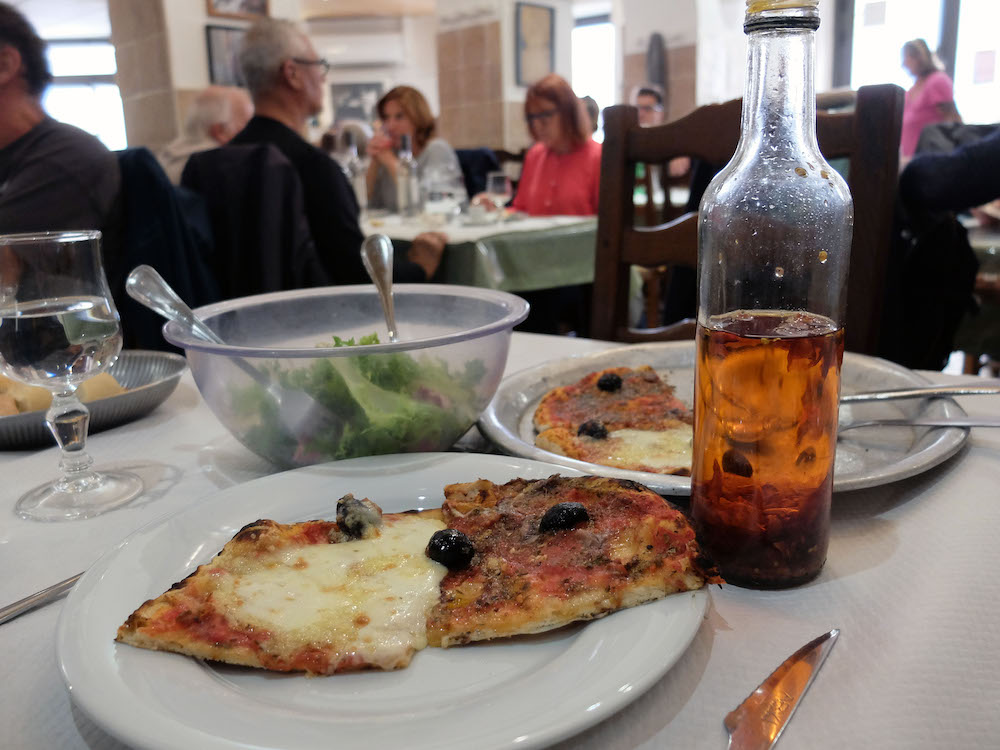
“Those who don’t know Etienne, don’t know Marseille,” insists a French weekly in a piece about the cult pizzeria. They were raving about both place, Chez Etienne, and person, the enigmatic Etienne Cassaro, who transformed the worker’s canteen his Sicilian dad opened in 1943 into a local institution that endures today. Though Etienne’s light went out in 2017, his son, Pascal, continues to carry the family torch – alongside a long-standing staff who have been there for decades. Aptly located in the equally mythical Le Panier quartier, Chez Etienne is home-style cooking served in a homey setting. Inside a convivial room divided by stone archways, the tables are packed with regulars, tourists and politicians from nearby city hall (including Mayor Gaudin) who tuck their ties in their shirt to keep them from getting splattered with pizza grease.
Fox Coffee

Outside of an airy pink wedge of a building off of Praça do Chile, protected from the bright midday sun by an awning with “Fox Coffee” printed on it, we waited with great anticipation for lunch: cachupa do curaçao, a specialty of the house which involves stuffing a leaf of steamed Lombardo cabbage with stewy cachupa and a poached egg. This was our third visit to the so-called “King of Cachupa” and we were working our way through the menu trying to identify what was so different and superior about this cachupa, the signature dish of Cape Verde, a former Portuguese colony situated off of the coast of West Africa.

Nicos

It’s hot in Mexico City and Gerardo Vazquez, head chef of Nicos Restaurant, is thinking about cooling off. “Spring in Mexico City is hot,” he says, “And for me, it is very connected to Lent…so, fresh foods, cool things, vegetable-focused dishes.” Tostadas are on the menu at Nicos today – crunchy baked tortillas, one with a cobia fish ceviche, and another with smoked trout, yogurt, arugula and tomato – as well as an Acupulco ceviche with olives and capers, and a cool mango ceviche.

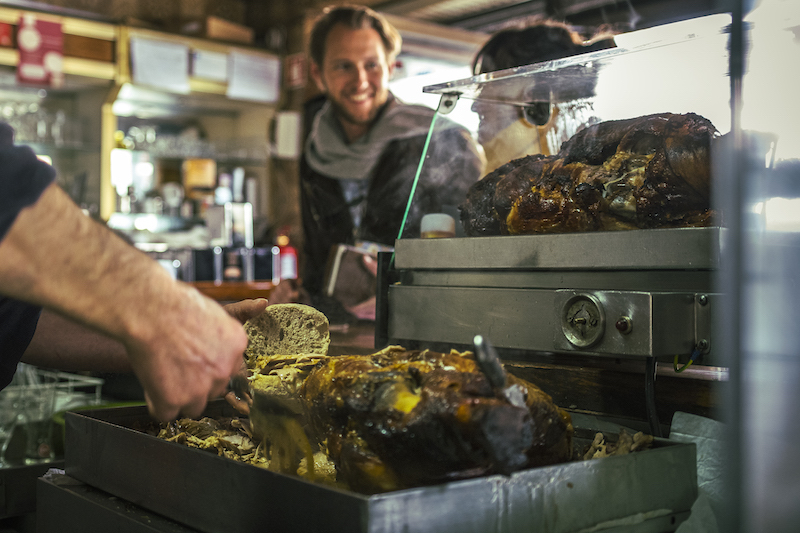
Preparing the sande de pernil (roast pork sandwich) at Casa Guedes, photo by António Morais

Forget the famous francesinha. The best sandwich in Porto – arguably in the country – can be found in a little 1970s tile-lined eatery; the unremarkable interior belies the iconic status of its most celebrated dish. Served up on the corner of Praça Poveiros, a square named after the fishermen from the storied maritime city Póvoa de Varzim, located just north of Porto, the sandes de pernil (roast pork sandwiches) are a curious joy to watch being assembled as well as, of course, to eat. One by one, roast pork legs are slowly cooked in the huge oven in the kitchen behind the bar of Casa Guedes. They are then served directly from the roasting tray by the owner himself, Mr. Cesar.

CB Book Club

Author Zach Mangan, founder of Kettl, a tea and teaware company based in New York City and Fukuoka, Japan, shares the stories of tea producers and craft of tea-making in his new book, Stories of Japanese Tea: The Regions, the Growers, and the Craft (Princeton Architectural Press, 2022). Originally a jazz drummer, Mangan first experienced fresh Japanese tea in Paris while on tour with his band in the mid-2000s. Following a two-year stint at Ito En, one of Japan’s largest tea distributors, he slowly built relationships with Japanese tea growers over several years, and began supplying tea to some of the best chefs in New York City. Kettl was eventually launched in 2015, and now has two locations in NYC.

Échale Ganas

For many people during the pandemic, the need to have a restaurant experience was supplemented by picking up food to go. Knowing that potential customers were on the lookout for something special during this time, Victor Villa of Villa’s Tacos in Highland Park, a historic Mexican enclave in Los Angeles, supplied not only the perfect dish, but also a unique ordering system that allowed Villa’s to continue serving the community. Every Tuesday at noon, customers test their luck as they try to send in their order via direct message on the Villa’s Tacos Instagram page, hoping to be one of the 350 or so lucky few who make the cut before the tacos sell out.

É Um Restaurante

When Crescer, a non-profit association focused on the social integration of Lisbon’s vulnerable populations, was tasked by City Hall to create a restaurant that would serve the homeless three years ago, the association’s top brass had another idea. “If you give a man a fish, he eats for a day. If you teach a man to fish, he eats for a lifetime.” With this saying as their guiding philosophy, Crescer proposed a different venture: a restaurant where the homeless could gain professional experience and training that would allow them to integrate into the community and find a job. In other words, tools for a better future.

CB Book Club

Popularly known as “Rice Girl” for her rice subscription service serving up micro-seasonal blends of rice varieties, Momoko Nakamura has had an eclectic career: she’s been a former television producer of food shows like Iron Chef America, start-up founder, director of food events, restaurant consultant, and now, advocate for healthy living and author of culinary guide Plant-Based Tokyo. Beautifully photographed by Waki Hamatsu and published in 2019, this bilingual book showcases 45 dining establishments in the Tokyo and Shonan areas that focus on plant-based cuisine and sustainable food system practices. But it’s much more than a restaurant directory: it’s a series of profiles or mini-biographies of plant-based chefs around the city.

LUFU, Let Us Feed U Indian pop-up in New Orleans, photo by James Cullen

In New Orleans, they have good Indian food, but not great Indian food,” said Chef Aman Kota. “And that’s why we started this.” The “this” in question is LUFU, or Let Us Feed U, a plucky Indian pop-up whose aim is to introduce New Orleanians to the complex regional cuisines of India, while also playing with British and American culinary concepts. LUFU is the brainchild of Sarthak Samantray and Aman Kota, two chefs who began their careers in India but didn’t meet each other until they started working in the kitchens of New Orleans a few years back, though they have the bearings of lifelong friends.

969 NYC Coffee

Mitsumine Oda's original idea for 969 NYC Coffee, in Jackson Heights, was just what the name suggests: a simple, small coffee shop. The bright yellow awning shows a wispy "969" – Oda's favorite number, we later learn – rising from an "NYC" cup. The side of the awning, however, reveals that this is much more than your average neighborhood coffee place. In bright green lettering, it reads matcha (powdered Japanese green tea and the beverage made from it) and onigiri, accompanied by the terse explanation "rice ball." Left unmentioned, at least until we climb a few steps to the small covered patio and within reading distance of a review affixed to the window, are onigirazu.

Marsel Delights

From syrup-drenched baklava to creamy milk puddings, Turkey has no shortage of sweet treats. But perhaps none have intrigued foreign visitors to Turkey as much as Turkish delight. Lokum is famous in the English-speaking world as the enchanted confection that entices Edmund to join the White Witch in The Lion, the Witch, and the Wardrobe, but in reality, the sticky sweet has been enchanting audiences since it was first developed in the early 1800s. Dubbed “Turkish delight” by English traders, lokum inspired a wave of imitators across Europe. “Lokum predates gummy sweets – gummy sweets were made trying to replicate Turkish delight. They didn’t know the secret ingredient, which is to manage the pH level,” says Selim Cenkel, founder and usta at Marsel Delights.

logo

Terms of Service