S M B O measurement-vertical measurement-vertical

Latest Stories

It’s Back: Porto’s Beloved Mercado do Bolhão Reopens

It took four years and four months, but Mercado do Bolhão, Porto’s central market and historic icon, finally came back to life in September. The first to arrive at the reopening was Nossa Senhora da Conceição, the market’s patron saint, whose image was installed in front of the new structures that are now part of the centenarian building. Located at the entrance to the grand market, which measures more than five thousand square meters, the saint's image welcomes the visitors who have filled the new space every day since the doors finally opened.

Recipe: Caril de Frango, The Cross-Border Curry Chicken

Casa da Índia is not, despite the name, an Indian restaurant. The menu boasts a pretty standard repertoire of the type of hearty, meat-and-potatoes dishes one would associate with Portugal: grilled sardines, salt cod baked with cream, stewed fava beans. “This space used to be a warehouse for spices,” says Paulo Campos, Casa da Índia’s manager, when asked about the restaurant’s rather misleading name. “We’re close to the river, so this is where spices, coffee, tea and other things from India were stored. The owners wanted to retain this legacy, so they gave it this name.”

Owners Auregan Dean and Mathieu Zurcher at Bouillon restaurant and wine shop, photo by Annie Etheridge

Le Mistral, as the strong northwesterly wind is known here in Marseille, returned on a recent September day for the first time in a long while. It is an indicator of the change of seasons and that autumn is upon us. A driving wind that blows directly down the Rhone Valley to the Mediterranean, it averages 30-50 miles per hour. Le Mistral is so celebrated that for 30 years, Marseille has held La Fête du Vent (The Wind Festival) and ironically, it coincides today with its return. It is also the reason that we enjoy 300 days per year of luminous, sunny skies. The wind is said to bring good health, and one reason for good wine, because it clears the vines and dries the soil.

Le République: Social Solidarity

Le République may be one of the most beautiful restaurants in Marseille. A historic space that once housed Café Parisen (from 1905, with its boulodrome for games of pétanque on the lower floor), it has been elegantly renovated and was reopened at the beginning of 2022 as a restaurant gastronomique solidaire—a gourmet “solidarity restaurant” and unique community project that embraces both guests and workers. But, without reading about it, diners would never guess this. Instead, they would take a table in the luminous space (1200 square meters!) with minimalist aesthetics, lofty ceilings, cornices, and great, dried flower-and-leaf chandeliers. There, they would discover Michelin-star chef Sébastien Richard and his team’s delightful creations, refined and simple, kindly served. Unknowingly, these guests participate directly in Le République social project.

Katsuo Shokudo: Fishy (Breakfast) Business

It’s a Thursday morning at Katsuo Shokudo, a basement breakfast diner in the backstreets of Shibuya decorated with fish-themed paraphernalia. Today is slow and relaxed. Dressed in shades of indigo, most notably a T-shirt proclaiming “KATSUO 100%,” proprietor Mai Nagamatsu is a one-woman show in charge of the entire operation today, washing and draining rice, frying fish, taking orders, sharpening her knives, now and then breaking out with a stream of lively banter in her bright, ringing voice. The name of her restaurant translates to “Skipjack Tuna Cafeteria,” and as the name suggests, it’s all about the eponymous fish. It specializes in all things katsuobushi, or skipjack tuna flakes – the smoky, piscine backbone of Japanese cuisine.

Liquid Assets: Lagidze Water, Georgian Nectar Featured Image

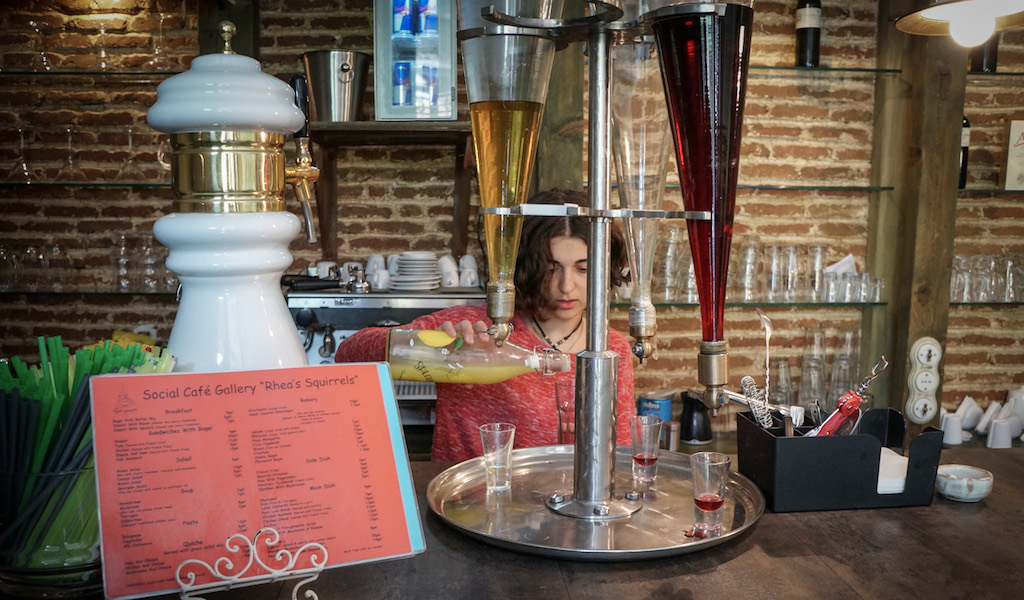
It was our first Tbilisi summer stroll down the city’s main drag, Rustaveli Avenue; two sweaty, newly arrived pie-eyed tourists tripping on the 2001 reality. There were billboards advertising the recent kidnapping of a Lebanese businessman, policemen in crumpled gray uniforms extorting money from random motorists with a wag of their batons, and at the top of the street, a former luxury hotel looking like a vertical shanty was full of displaced Georgians from Abkhazia. Parched and cotton-mouthed, we entered a café of sorts for cool respite. The room had high ceilings, was stark and all marble-tiled, including the long, wide bar. A splendid social-realism mosaic of women, grapes and wine was laid into the back wall. The counter was decorated with a few tin ashtrays and a spinning rack holding several tall cone-shaped beakers filled with technicolored syrups.

Espai Mescladís: Cooking Opportunities

During our visit to Mescladís Borrel Restaurant & School, Victoria Gio, coordinator of the Mescladís program, is on the phone for a long time. She smiles and looks around trying to find someone – she has good news for one of the students. It is Ibrahima, a tall, shy student from Senegal who at the moment is concentrated on preparing bissap, a delicious hibiscus flower infusion that is served as cold refreshment in the Mescladís restaurants. Ibrahima has secured a job in a local restaurant, and together with Gio will start the process to help him to arrange all the documents he needs. We congratulate him.

Xinjiang Sasadilo: Uighur Culinary Oasis

When it first opened in 2017, Hualing Tbilisi Sea Plaza was supposed to be the largest shopping mall in the South Caucasus. But all signs suggest that the gigantic commercial center has yet to live up to its great expectations, with one journalist noting that at times “shoppers were outnumbered by shops.” The mall was one of the flashy elements of a $170 million investment by the Chinese Hualing Group that went into transforming 420 hectares of a desolate eastern Tbilisi suburb called Varketili into Hualing Tbilisi Sea New City, with developments that included a colossal glass-shrouded 5-star hotel, rows of 10-story residential complexes and expansive avenues that abruptly adjoin wiggly side streets at the borders of the project site.

Paulo Amado: Cooking Up Change

The annual Congresso dos Cozinheiros (the Congress of Cooks) returns to Lisbon this 25th and 25th of September, with two days of events, workshops and conferences. It’s one of the highlights of the year for professional chefs, but also an event open to all food and restaurant lovers. The theme of this year’s Congress is a particularly rich one: Conexão Africana – the African Connec-tion. The gathering is organized, as always, by Paulo Amado, a man who has battled and worked end-lessly for chefs and restaurants in Portugal. Paulo is a jack of all trades; an author, musician and songwriter. He is perhaps most widely known for Edições do Gosto, his multidisciplinary company dedicated to Portuguese gastronomy.

Kondo Honten

Japan is well known for its variety of national dishes, as well as local specialties claimed by individual regions and cities. Tokyo, which boasts more Michelin stars than any city in the world, is a natural nexus for these disparate eats, as well as more international fare. It may come as a surprise, then, that Tokyo itself only really has one true homegrown specialty: monjayaki. The baseline ingredients for monjayaki, often referred to simply as monja, are nothing more than wheat flour and dashi, that ubiquitous Japanese broth made from kombu (kelp) and shavings of katsuobushi, dried, fermented and smoked skipjack tuna. Cabbage is also common enough to be considered a third basic ingredient.

Take It Outside: Barcelona’s Best Outdoor Dining Spots 2022

It has been an endless summer in Barcelona. The temperatures are historically high and use of public air-conditioning historically low due to government-imposed energy saving measures. We are learning to live with what looks like a constant heat wave, where the best hours of the day start at night. The city is now recovering its social and cultural activity after the holidays and the urban and green spaces, with its open-air terraces and inner patios, are still the authentic heart of the city where to meet up with friends and indulge yourself with a delicious bite and a cold glass of wine.

CB On the Road: Culinary Secrets of Dewa Sanzan’s Mountain Monks

Much has been written about the yamabushi of the Dewa Sanzan mountains in Yamagata Prefecture, about two and a half hours north of Tokyo via bullet train. The yamabushi are followers of Shugendo, an ascetic mountain religion best thought of as an amalgamation of Shinto, Buddhism, Taoism, and mountain worship. Shrouded in secrecy and more than a little mystery, their ascetic practices might seem more like superhuman feats to the layperson: yamabushi famously commit to often physically grueling, spiritual practices of self-denial, like circumambulating mountains on straw sandals year-round, or meditating for hours under freezing waterfalls. Food might not seem of great importance while in pursuit of enlightenment, but it turns out that what you eat in your spiritual practice is just as important as your other activities.

Spiedo d’Oro: Neapolitan Gold Featured Image

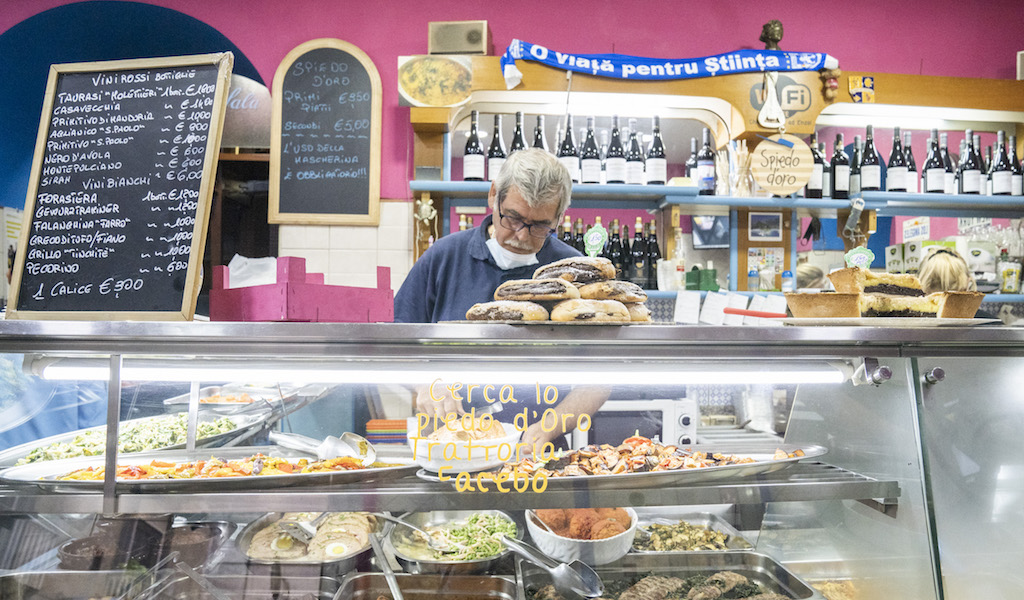
Behind the counter at the modest Spiedo d’Oro, owner Vincenzo Monzo and his wife Cinzia have something welcoming to say to every customer who walks in. “The eggplant parmigiana will be ready in 10 minutes.” “The pasta and beans have just come out.” “Salvatore! You alone? No wife? We'll make you a plate of Genovese, and the gattò is on its way.” With a few spartan tables and a glass-lined counter where you can see everything that is available for lunch, Spiedo d’Oro is the definition of a no-frills joint. Like everyone around us, we’ve come here not just for the warm welcome but also for the simple but excellent Neapolitan dishes.

Varenyk House: Taste of a Ukrainian Childhood

“Taste of childhood." At Varenyk House, a Ukrainian deli-grocery in Ridgewood, this hand-lettered sign for imported halva – made not from sesame but from sunflower seeds, which are much more widely harvested in Eastern Europe – seemed poignant even when we first saw it, early in 2022. The sentiment has become only more heartfelt since Russia's unprovoked and vicious invasion of Ukraine. The owner, Stepan Rogulskyi, lives with his wife, Natalya, and their two young daughters in Maspeth, the Queens neighborhood just north of Ridgewood. His first home, however, was the city of Truskavets, in western Ukraine; his two brothers, his parents and his paternal grandmother still live there, or nearby.

Asia Lounge: A Community of Biryani

Across South Asia, arguments over which biryani is the best are not uncommon. For those from outside the region, differences in biryani are often reduced to “good versus bad,” but for those from South Asia, those differences can separate a tasty rice dish from the true taste of home. “To the world, it’s South Asian food,” says Nasruzzaman Naeem of Istanbul’s Asia Lounge Café, “but, to us, there are differences.” At the Asia Lounge Café, Restaurant and Cultural Center in the Ali Kuşçu neighborhood, two out of every three customers have a plate of biryani in front of them. To the initiated, this is kacchi biryani, kaccha meaning “raw.”

logo

Terms of Service