S M B O measurement-vertical measurement-vertical

Latest Stories

Ekume, Marseille, photo by Medi Musso

Écume is French for sea foam. Modifying one letter, Ekume is also the Saint Victor neighborhood’s new restaurant gastronomique that summons (and is summoned by) the Mediterranean every day. Located near the end of Rue Sainte in Marseille, Ekume’s neighborhood includes a promontory with thrilling views of the waters, boats, coastline and the Vieux Port. The restaurant is also one block away from the 5th-century Saint Victor Abbey, with its evocative beauty and occasional evening concerts. At first glance, Ekume, with its staid and comfortable décor in tan, beige, and slate blue, seems to correspond to the many bougie restaurants cropping up in the 7th and 8th arrondissements in recent years. The experience of dining at Ekume, however, offers the opportunity to contemplate how space itself can transform with imaginative cuisine, accents, personality, and hospitality.

eating vietnamese food in new orleans

Beignets & More is the kind of place you want everyone to know about – and you don’t want anyone to know about. Tucked between a defunct Cineplex and an Off-Track Betting location in a strip mall in Chalmette, a downriver suburb of New Orleans, it is a family-run gem of Vietnamese cuisine. But the name is a cloaking device of sorts: The beignets, which are made fresh daily, seem like an afterthought. Until recently, we’d never even had them. In all the years we’ve taken the short drive to this nondescript restaurant, we have always stayed on the “More” side of the menu.

First Stop: Javier Cabral’s L.A.

Editor’s note: In the latest installment of our recurring First Stop feature, we asked Javier Cabral, the Long Beach-based Editor in Chief of L.A. TACO, where his go-to spots are in L.A.’s last-standing working-class beachside community. He is the former restaurant scout for Jonathan Gold, the Associate Producer of the Taco Chronicles series on Netflix, and the author of “Oaxaca: Home Cooking From the Heart of Mexico” and “Asada: The Art of Mexican-Style Grilling.” Javier has been having the time of his life tasting through all of the Cambodian, Laotian, Thai, and Vietnamese noodles in Cambodia Town and Little Saigon in Westminster. Follow him and L.A. TACO on Instagram. Confession time: Moving to Long Beach straight-up reinvigorated my passion for eating out in my home city. Mainly because living in the middle of L.A.’s Cambodia Town and its universe of dank noodles, beef sticks, and mango salads is a hell of a lot more exhilarating than the wave of post-gentrification restaurants that have opened in Highland Park in the last decade.

Ali Dayı'nın Yeri: Peripheral Chickpeas

Istanbul's western suburb of Küçükçekmece is flanked by a small lake of the same name, the water of which flows from a river in the north and out into the Marmara Sea in the opposite direction. The coastline of the lake is just steps away from a train that stops at the foot of the Cennet neighborhood, where a hillside of ramshackle, single-story houses with gardens look out over the water. At the top of the hill, the neighborhood takes on a more modern character with six-story apartments and a bustling pedestrian avenue packed with cafes and restaurants.

Farewell Senhor António: Remembering a Lifetime of Kindness

Senhor António, the keeper of one of the oldest grocery shops in Lisbon, Mercearia Celta, died two weeks ago. With his passing, Culinary Backstreets Lisbon lost a dear friend and the city lost a living link to what is an increasingly disappearing past. “That’s life.” This phrase would end most of our conversations and visits to his tidy, old grocery shop. António da Fonseca, or Sr. António, as we knew him, was the most beloved inhabitant of the Campo de Ourique neighborhood and his corner shop a true neighborhood institution. He regularly welcomed guests on our Lisbon Awakens tour with never-ending enthusiasm and would be, for most visitors, the highlight of their walk.

Spring Gone Wild

One of the great joys of spring in Japan is anticipating the appearance of sansai, or mountain vegetables. When cherry blossoms begin to flutter on warming breezes, hikers take to the hills to forage for the first wild edibles. Supermarkets mount special displays of packaged (and unfortunately often hot-house-raised) young sprouted leaves, shoots and tubers. Restaurants proudly offer up special seasonal dishes, providing an opportunity to bring the freshness of the outdoors to the table, even in the inner city. A bounty of deliciousness awaits those fortunate enough to get out of Tokyo and roam the hills. Fukinoto, taranome and warabi form a trifecta of green vegetables gleaned from mountain walks. Cooks wait all year to prepare dishes of these fragrant yasai veggies.

Butter beans and rice, Crawbabies LLC, New Orleans, photo by James Cullen

Bunny Young, clad in a bright red chef’s coat and matching hat, stands in the galley kitchen of her New Orleans East home slowly stirring a pot of butter beans. She has done this thousands of times, but each time is a prayer offered to her ancestors, the generations of New Orleans 7th Ward Creole women who guided Young in the kitchen. Young is not for the faint of heart. Her bold flavors, bold personality and bold sartorial choices are reminiscent of Leah Chase, another legendary Creole chef. Young has a lot on her mind at all times, and she isn’t afraid to tell you, either. But these days, she lets her food do most of the talking, and it, too, has a lot to say.

Rebuilding, Bite by Bite: Historic Antakya After the Earthquake

In the main hall of Antakya’s bus station terminal, there are deep cracks in the walls, rubble litters the floor and dozens of ceiling panels seem to hang on by a thread, the entire thing threatening to collapse at any moment. Bus companies have set up mobile desks outside of the station, and it is from one of these where I buy my evening ticket back to the city of Adana, about four hours to the west by bus. Even though I've just arrived, I already have to plan my exit because there isn't really anywhere left in Antakya to stay the night. Like most structures in the city, the terminal was damaged in February's massive earthquake, the worst of its kind in modern Turkish history.

La Sosenga: Modern Medieval

“It is a recipe similar to a meat stew that originally was made with game or fish. We do it with beef cheek – a very traditional ingredient now in Catalunya, but which in those days was not so frequently used. It goes with several herbs and spices like parsley, thyme and marjoram, plus cinnamon and clove, all cooked with lard and honey from the Sierra de Cádiz, made by Tania’s family.” This, in words of the chef Marc Pérez, is a Sosenga, a medieval dish and the name of the restaurant he recently opened in the Gótic neighborhood with his partner in life and work, Tania Doblas.

Spring in Tbilisi: Tarragon, a Love Story Featured Image

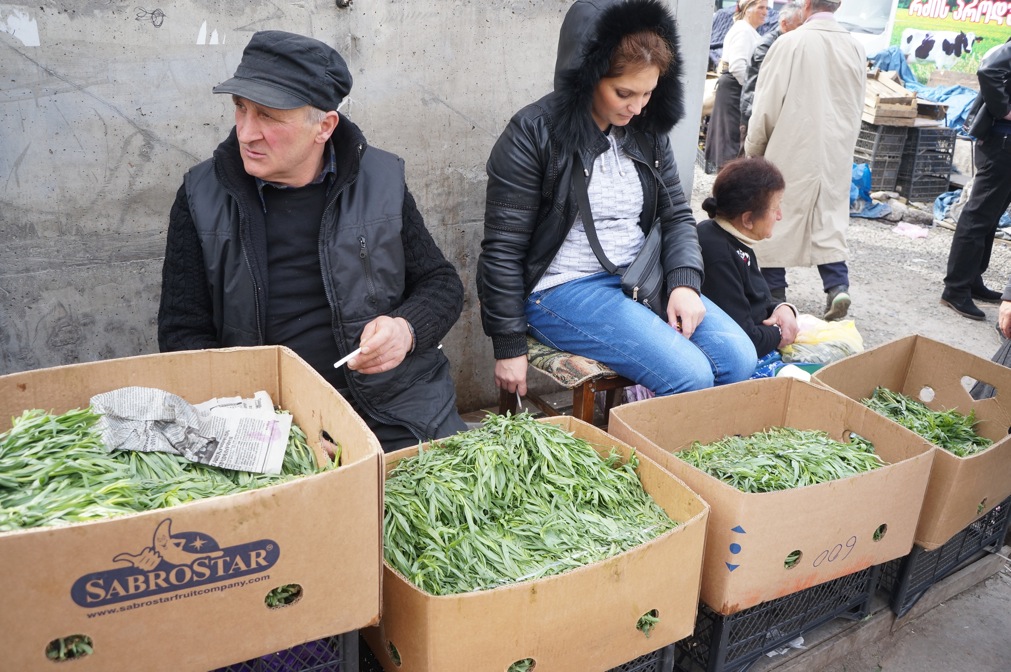
At the cusp of winter’s end, men across Georgia balance on wobbly ladders and trim their grapevines. The clippings will be used later for baking bread in traditional tone ovens and for roasting mtsvadi, skewered chunks of pork, on the embers. Only after the trimming is completed throughout the land is springtime allowed to arrive. And when it comes, it does so in teasing bursts of bold flavors, juicy colors and luscious aromas. The first indication of spring is the arrival of tarkhuna – tarragon – at the central bazaar, where we love to shop for produce.

Caterine: The Quaint Canteen

Rue Fontange is a narrow street with small, inspired businesses that seem to complement one another. The vitrine of Vinyl is lavishly covered in white-marker script, through which we can still see wine, records, and meals by Oumalala (now serving here); across the street is Gallery Charivari, which when we visited was featuring Syrian artist Khaled Dawwa’s astonishing sculptures from his Compressés series, different takes on a heavy man slouching into a chair; further along lies the fine book selection of Histoire de l’oeil, with its garden and cabanon out back, a small red shed we can also see if we walk straight through Caterine restaurant next door to its dining patio, which feels like a continuum of the same garden.

Bottega Monteleone: Perfect Pairing

Let’s face it, it’s hard to find a calm spot in Palermo’s city center. Some evenings, one simply wants to exchange the honking of cars for the uncorking of wine bottles, hidden away from the splendid excess the city has to offer. Such an escape exists at Bottega Monteleone, located on a small, quaint pedestrian walkway, which bears the same name as the wine bar. In this tiny bottega, you’ll be treated to an abundance of wines and Sicilian specialties, as well as the hospitality of the bar’s owners, Katharina and Angelo. The Bottega pays homage to the different geographical origins of the owners. Its appearance is unmistakably Palermitan but its history is reminiscent of an old factory (in this case actually a garage) turned into a chic bar – typical of the former East Germany, where Katharina grew up and studied.

The Perfect Spring Day: Los Angeles

Los Angeles winter is typically mild, sunny and dry (notwithstanding this past winter), so here it isn’t the warmer weather we await for every spring. Still, for a multitude of reasons, spring is a season many Angelenos celebrate. For me, spring signals the arrival of wildflowers and the beginning of spot prawn season, two uniquely Californian events that I anticipate each year. As California’s official state flower, the poppy flowers in Antelope Valley are the most popular wildflowers, but the poppy reserve tends to be way too crowded – especially on superbloom years. I like to head to Malibu instead for my wildflowers. The drive north along the ocean on Pacific Coast Highway is one of the most beautiful in L.A. – we could even already see some wildflowers along the way.

Sami’s Kabab House: Afghan in Astoria

Almost before we’d sat down, tea and rice pudding had arrived at our table. “This is the way I was raised,” Sami Zaman explained. We’d arranged a time to speak with him at his namesake Afghan restaurant in Astoria, Sami’s Kabab House, and we’d quickly discovered that refreshments were an essential prelude to our conversation. Sami is always “working, working, working,” he tells us, but during our visit he also had a smile and a greeting for everyone who stepped into his kabab house. Between spoonfuls of pudding, we asked about the roots of his hospitality.

Bop Dumpling, photo by Gianni Cipriano and Sara Smarrazzo

Luca Affatato opens the unmarked single shutter on via Battistello Caracciolo – a charmless street linking the Avvocata and Arenella hill boroughs, at a few steps from the Salvator Rosa Metro Art Station – most days at 7 p.m. If he doesn’t, it’s for two possible reasons: either he’s busy at a popup event at some other Neapolitan venue, or he has run out of his one-and-only dish – Asian-style dumplings – and needs time to make new ones. In any case, he warns his faithful patrons on Bop Dumpling’s Instagram feed, which is pretty much the only way to be updated about opening times, menus, events and a bit of Affatato’s private life, unless you have his mobile number – which many customers do.

logo

Terms of Service