S M B O measurement-vertical measurement-vertical

Latest Stories

Pictograma

For a dish so ubiquitous, one would be forgiven to think there’s little to debate about Georgia’s national dumpling, the khinkali. But just as tastes vary, every Georgian has their own khinkali preferences and opinions. That’s certainly the case for chef Gela Arabuli, who believes khinkali has been gentrified and mass produced to a point where most people have forgotten the dumplings’ origins in the mountains and how they should really taste. “Real khinkali is from the high mountains. And there are no pigs in the mountains,” insists Gela, referring to the most popular and common filling of minced beef and pork in equal parts as kalakuri, or “city style,” khinkali.

La Chubechada: Michelada Madness

On a neighborhood back street, hemmed in by cars on both sides, sits a house-turned-secret dance club, a girl selling Maruchan soup-in-a-cup under a pop-up tent, and La Chubechada – a tiny storefront with a cutout window just big enough for Maria Guadalupe to poke her head out and take your order. When your drink comes up and she hollers out your name, you better be quick on your feet to go pick it up. For tourists venturing out of the center of Mexico City, La Chubechada feels far from the trendy spotlight and more than a little intimidating, but upon arrival the place hums with a neighborhood vibe – kids hanging out and getting tipsy on the sidewalk with their friends, locals stopping by to say hello.

Buriti: Brazil Comes to Barcelona

The buriti, which grows in wet riversides and swamps, is among the most splendid of South American palms. This tree has special significance in Brazil: it is even an unsuspecting main character in the Brazilian epic novel The Devil to Pay in The Backlands, written by João Guimarães Rosa. For the Guaraní, an indigenous group of the southwest of the country, the buriti palm is a generous being from which each element can be used: fruit, bark, leaves, oil – it’s why its name means “Tree of Life.” Now, a new Buriti has flourished in Barcelona, just a stone’s throw from the shore in the beachside Poble Nou neighborhood. A Brazilian restaurant full of nostalgic flavors prepared with great skill and served in portions to share tapas-style, but with an authentic Brazilian taste.

Customers enjoy the food and the view at the food truck Le Bon Air, photo by Annie Etheridge

Summer in Provençe ushers in a multitude of promises. In Marseille, it means waking to the song of the cicadas, day trips by boat to le Frioul to cool off in the sea and the afternoon rendezvous with friends for an apéro of pastis or rosé on ice. Saturdays bring the bliss of wandering through the markets in search for the perfect melon from Cavaillon, the ciflorette strawberries from Carpentras, or the succulent coeur de boeuf tomato. Perhaps the one market item that signifies the Provençal summer more than anything else is the fleur de courgette (zucchini flower). When this lovely little flower appears, we know it is officially summertime in the South.

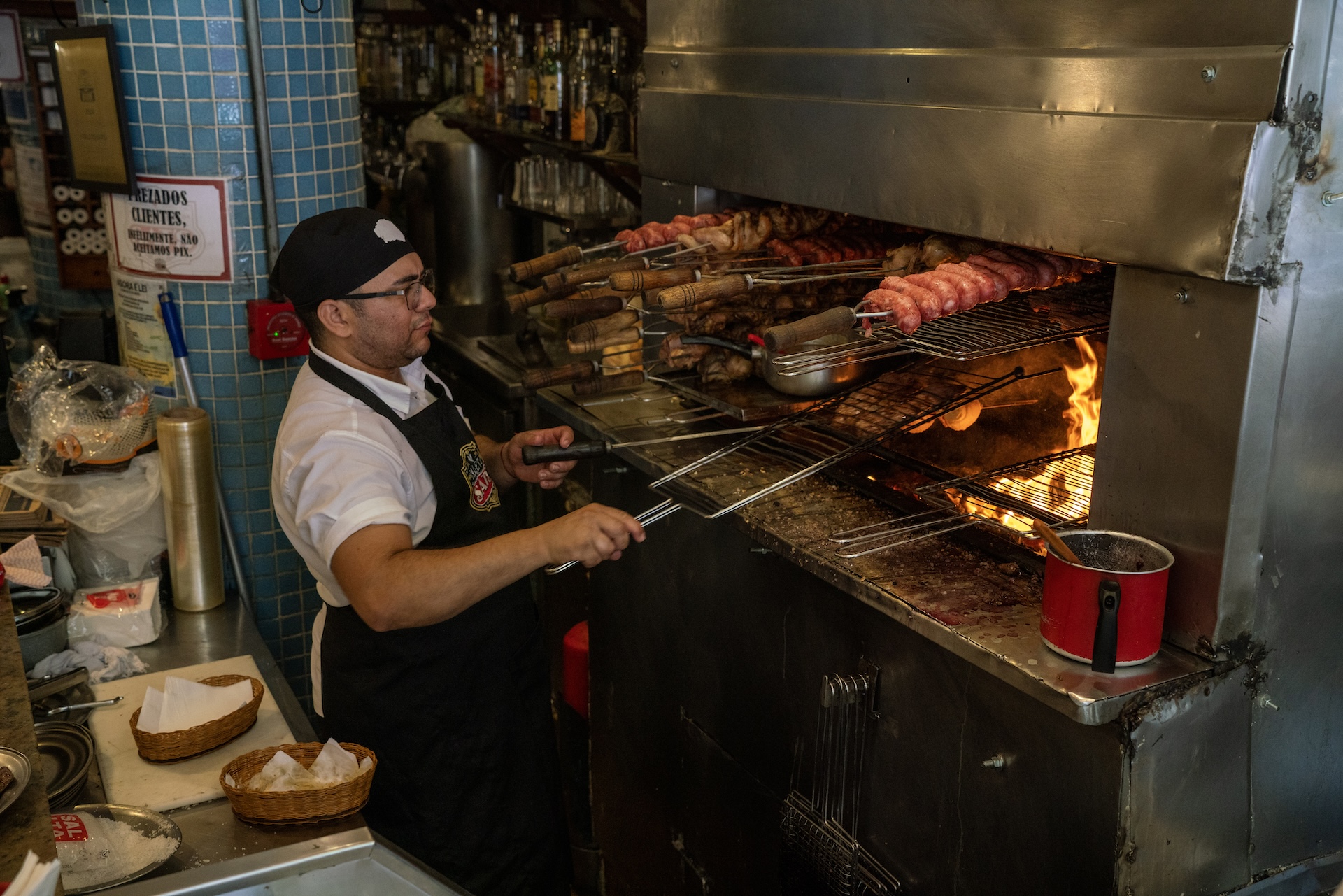
Galeto Sat's: Spring Chickens and Sugarcane Spirits Featured Image

Although there are plenty of bars on Copacabana’s famous Avenida Atlântica – or even at the beach, at the so called quiosques – very few are worth a visit. Many are just tourist traps. Others are much too expensive. No, the really good bars in Copacabana are inland, along Barata Ribeiro street. That road, along with some of the side streets that let onto it, reveals the true face of Copacabana's popular gastronomy. One of the first bars you encounter on Barata Ribeiro is Galeto Sat's. Open seven days a week, always until 5 a.m., the bar is a bohemian temple – but it’s far from being only that. For many cariocas, Sat's serves the best galeto in town. A galeto is a very young chicken (no more than three months old) cooked over a big coal-fired grill.

Deeney’s Tokyo: Haggis Outpost

Stumbling upon a haggis toastie store in the middle of Tokyo sounds like a half-remembered dream where nothing quite makes sense. It was the minimalist black store front with white type that had initially drawn us to it. It looked like a store straight out of London, and certainly not like a café that one would expect to find next to Japan’s Olympic stadium. Its menu dripped with promise: toasties (toasted sandwiches) stuffed with glorious cheese. And real bread, granary bread, something we’d never spied before in Japan. Loaves of it were stacked in rows above the counter, and a griddle sat to one side, where butter-slathered slices, jammed packed with fillings, were being flattened into crispy parcels.

Al Fresco: A Fresh Start

Upon entering Al Fresco in the Ballarò neighborhood, we are struck by both the kind welcome and the special location – the restaurant is set in a garden enclosed within the walls of Casa San Francesco, a former seventeenth-century convent, lit by strings of lights dangling between plants and saplings. There is an immediate sense of openness, freedom and freshness. This is no coincidence: while “al fresco” in Italian can refer to the chill of being out in the open air, it is also an expression used to mean “life in prison.” The double meaning makes sense in this case – despite its first impression as a regular eatery, perhaps the most special feature of Al Fresco is that working in the kitchen and in the dining room are former inmates who have joined the team following their release from prison.

ScottoJonno: Born Again

The Galleria Principe di Napoli’s beautiful arcades and art-deco ceiling made of iron and glass – built in the second half of the 19th century at the site of an ancient grain storehouse – stood silent for long time. Once a buzzing commercial and cultural hub in the heart of the city, with two of its three wings connecting the National Archaeological Museum to the Academy of Fine Arts, the Galleria was confiscated during the Fascist era and used to project propaganda films, shutting down its shops and venues. In the eighties, it was used for public offices for a time before it was left abandoned. Recently, though, the space has been brought to life, thanks to a call for bids and a handful of businesses that took on the challenge, such as a bike shop, a B&B and the lovely Lazzarelle Bistrot, among others.

Mezcalite Pop: Oaxaca’s Ice Queen

Oaxaca City has a mysterious hour, a period of the day when time is suspended. As we walk through a hot day of Oaxaca’s eternal summer, the sun is at its zenith and the mind starts slowing down. The streets feel emptier and quieter than ever, though the soundly closed doors hide lively households of buzzing fans and cool adobe walls. When we need respite from the heat, we remember that, just around the corner, salvation awaits at Mezcalite Pop, a lush paleta (popsicle) and ice cream shop that since 2017 has been an oasis in the middle of the green quarry stone desert of Oaxaca’s historic center, always surprising us with its bold, fresh creations.

La Delizia: Geniuses of Gelato

When we meet Mr. Giovanni Scalici, owner of the gelato shop La Delizia, he explains the formula for his success in one word: "Simplicity." We are in Sferracavallo, a seaside suburb of Palermo located between the mountains and a beautiful gulf. Here the coast is filled with dozens of seafood restaurants, but if you venture slightly off the promenade you will find this gem of a gelateria on Via Dammuso.

Le Greche

Evi Papadopoulou is no stranger to the culinary arts. A well-regarded food journalist who has written articles on pastries and desserts in the top Greek gastronomy publications, she is also a classically trained chef. She studied at the culinary school of renowned Italian pastry chef Iginio Massari and followed that up with specialized training in making artisanal gelato at Francesco Palmieri’s prestigious laboratory in Puglia, Italy. In July of 2014, Papadopoulou opened Le Greche, a gelato parlor tucked away on Mitropoleos Street, right off Syntagma Square. The parlor itself is straight out of an Alphonse Mucha painting and has an Art Nouveau feel, with its airy, muted color palette. Since it opened, the shop has accumulated quite a cult following – and for good reason.

Vanille Noire

When we first arrived in Marseille, we heard rumblings about a most intriguing ice cream flavor. A “black vanilla” whose color and savory taste was rumored to come from squid ink, fitting for the city’s Mediterranean perch. In a city where exaggeration is the norm, we had to go check it out for ourselves. A long line snaked from Vanille Noire, the name of both the ice cream shop and famous flavor. The vendor handed us our scoop, so black it looked like a photo negative of a vanilla cone. Our first lick was rich Madagascar vanilla. A few seconds later, the sweet became salty like the seaside air. We were hooked – regardless of what it was made of.

Cenaduría Doña Guille

As night falls, the commercial life in Guadalajara’s popular neighborhoods doesn’t fade – it transforms. Everywhere you look, food stalls pop up, offering tacos, tamales, elotes, churros, and other tasty street treats, all glowing under hanging lights. These spots become local hangouts where people can grab a delicious bite before heading home. Cenadurías – literally “dinner places” – were among the first popular ways to serve meals outside the home. They have existed since the 19th century in streets, garages, and small eateries in traditional neighborhoods like Mexicaltzingo, Santa Teresita, Mezquitán Country, and Analco. These venues serve comforting dishes and mainly cater to workers and merchants finishing their day, providing a last chance to eat without complications before calling it a night. They also become go-to spots for families seeking simple, homestyle meals at affordable prices.

Tetetlán, Mexico City, photo by Andrew Reiner

Stepping into Tetetlán feels like discovering a treasure that few others know about. Perhaps it's the sturdy stone wall facing the street, or the fact that the space is nestled among the imposing volcanic rocks that define this part of Mexico City, aptly called Jardines del Pedregal (Pedregal translates as “stony ground”). Or maybe it’s because there’s so much to explore inside: a restaurant, an art gallery, a boutique, a library, and a mindfulness center all coexist between the stones. And of course, there’s its famous next-door neighbor: Casa Pedregal, a stunning house designed by iconic Mexican architect Luis Barragán. Despite the many things going on in Tetetlán, the restaurant maintains a calm, inviting atmosphere. The walls are lined with artwork, and shelves filled with books infuse the air with creativity and inspiration – an energy that translates to the kitchen, too.

A basket of fresh fruit at the entrance to The Florist Bar, photo by Gianni Cipriano and Sara Smarrazzo

There are flowers all around us. Seeds and plants are scattered here and there. Herbs and fresh fruits rest in wicker and reed baskets. Sitting amongst all this glory is Stefania Salvetti, who is telling us about Paradisiello, where she lives. Meaning “Little Paradise” in Italian, Paradisiello is where Stefania has a home with 2,000 square meters of greenery, citrus trees and even chickens. The big surprise? What sounds like a glorious village outside of Naples is actually a quarter within the city, very close to the historic center. Il Paradisiello is a small, romantic, peaceful place just a few meters from the noisy city. A site where time seems to stand still, the air somehow more rarefied.

logo

Terms of Service