S M B O measurement-vertical measurement-vertical

Latest Stories

Leopoldo Cafebar – Senza Glutine

One of the problems for travelers with celiac disease is that they often can’t taste local gastronomic specialties. This is particularly true in Naples, a city famed for its pizza and pastries, such as the mythical babà; pastiera, the queen of Neapolitan sweets; and the ancient sfogliatella. Until about 20 years ago, it was very difficult for someone with celiac disease to eat in Naples; the number of restaurants equipped for gluten-free cooking could be counted on one hand, and they often had to resort to processed food products sold in pharmacies.

Behind Bars

The five-star Pera Palace is undoubtedly Istanbul’s most iconic hotel, with its palatial rooms and suites named after the legendary guests that stayed there, such as Agatha Christie, Alfred Hitchcock, Jacqueline Kennedy Onassis and Ernest Hemingway. Practically synonymous with the Istanbul of a century ago, it is the subject of a lovely tome, "Midnight at the Pera Palace" by Charles King, that locates the hotel within the fantastically tumultuous years leading up to and following the establishment of the Turkish Republic. Though we admire the Pera Palace and cannot understate its importance to the city’s modern history, it is not our favorite Istanbul hotel. That honor is reserved for the Büyük Londra (Grand Hotel de Londres), located just a stone’s throw away on the opposite side of the stately Meşrutiyet Avenue.

CB On The Road

It wasn’t so long ago that no one would venture to Georgia’s Svaneti region without a personal invitation, and even that was risky. Isolated, sky-high in the Caucasus, nestled between the breakaway territory of Abkhazia and the Russian Federation, it was land of the lost, inhabited by a tribe speaking their own language, living in hamlets dominated by tall medieval stone towers used for protection from invading hordes as well as from each other. Ancient pagan-Christian rituals, bride-napping, blood vendettas and banditry defined modern Svaneti – at least when viewed from the outside. We had heard too many stories of how oblivious tourists would wander there with cameras around their necks and big tourist grins only to return in their underwear with their heads hanging low. Like Georgians from the rest of the country, we stayed away.

Les Truites

If anything in recent history has bonded Spanish hearts, it was neither politics, language, flags nor even TV. It was the tortilla de patatas, the iconic potato omelet. In every house, bar and restaurant, the tortilla de patates is always treated with intimacy and respect, like some sort of communal great-great-grandmother. And in every Spanish city, you will find a list of the best kitchens offering this specialty. For Barcelona, one neighborhood temple devoted to the omelet is Les Truites, a small family restaurant in Sant Gervasi run by Joan Antoni Miró and his son Marc.

Jianbing

When we set out to create a foodie “holiday” this past April for jianbing, one of China’s most-loved street snacks, we didn’t know quite what to expect. Our aim with World Jianbing Day, which included giveaways and a social media campaign encouraging people to add their favorite jianbing spots in China and abroad to a crowd-sourced map, was to build awareness outside the typical jianbing consumer base. Locals who grew up with and already love the snack don’t need much reminding about the virtues of the perfectly balanced crepe from northern China. But everyone else? They need to know about the sweet, crunchy, pickled, spicy and salty elements all wrapped up in one convenient burrito-crepe-style to-go snack.

Building Blocks: Weeds and Edibles in Mexico City Featured Image

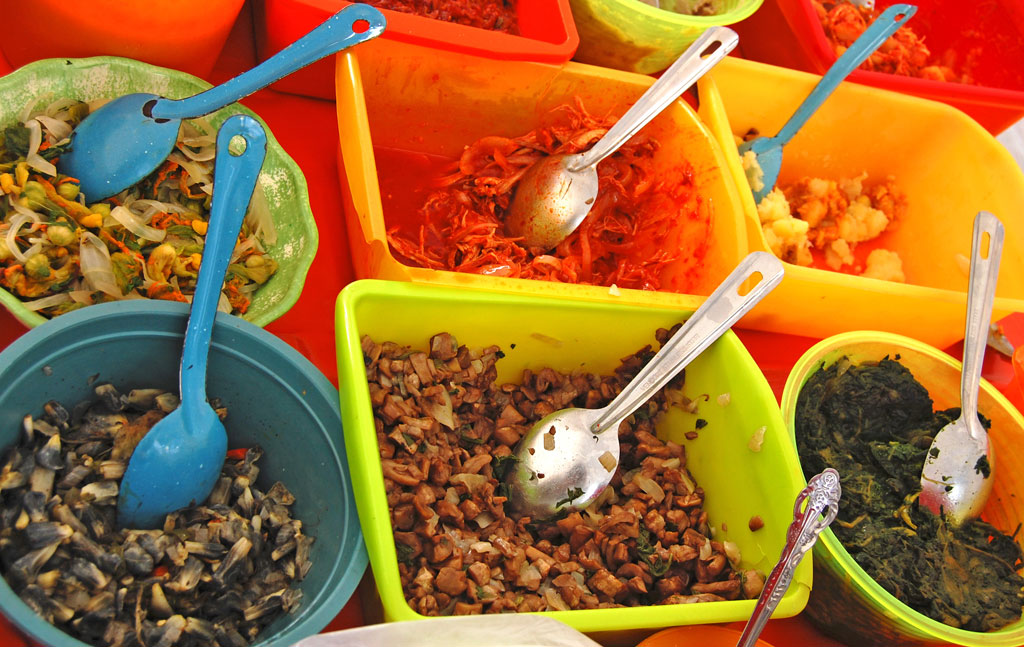
“I’m a vegetarian – what will I eat in Mexico other than beans and rice?” Taco-madness has so consumed the world’s view of Mexican cuisine that the traditional mainstays of the diet often don’t get the billing they deserve. Beans, corn, squash, chilies and tomatoes are grown together in milpa farms – a biodynamic system of agriculture. Anyone who has ever grown anything knows: if you let a garden grow naturally, you’ll have an abundance of leafy greens that most of us call “weeds.” Well, in Mexico, nothing edible goes to waste. Just as every bit of meat from an animal is used, so are those weeds and all the other tender leafy bits.

Cisterna Cafè & Bistrot

The typical Neapolitan breakfast is fast, often consumed standing at the espresso bar. A croissant and a quick coffee – and, boom, the day begins. Many people in the English-speaking world, however, will use coffee bars and cafès as a place to relax or work. They bring computers, connect to the Wi-Fi and, ordering just one coffee, may even sit for hours. Three years ago, a group of entrepreneurs decided it was time Naples had a bar where people could indulge in a lazy morning breakfast, a slow midday meal or a long afternoon tea – a place where the chairs are comfortable, the tables are an inviting wood and you are encouraged to stay and make your phone calls, write your papers and chat with friends.

Koutoukaki

A neighborhood on the southeast side of Filopappou Hill, between Acropolis, Petralona, Kallithea and Neos Kosmos, Koukaki was named after one of its first residents, Georgios Koukakis, who in the early 20th century opened a successful factory there manufacturing iron beds. Gradually the area developed into a charming middle-class neighborhood, full of life and – up until the 1980s – a place Athenians charmingly referred to as “Little Paris,” in large part because of its bohemian vibe. The lower side of Koukaki has long been a students’ area due to the nearby Panteion University. Rents used to be relatively low, but after the opening of the new Acropolis Museum in 2009, the surrounding area has been booming, growing into an Airbnb goldmine and turning many locals against the trend.

Taberna Albricoque

The Algarve, one of the most visited regions in Portugal, also has some of the country’s most distinctive and delicious cooking. Integrating layers of different historical influences, from the Romans to the Moors, along with fishing traditions and countryside rusticity powered by its fertile land, the Algarve has made a deep impression on Portugal. But until Taberna Albricoque came on the scene, the region hadn’t been making much of an impact on Lisbon menus. Bringing the Algarve’s history to the forefront of Lisbon dining was one of the goals of chef Bertílio Gomes in opening his new restaurant. Albricoque, in fact, is the word for apricot in the Algarve, notable because the south has preserved its Arab etymology, as elsewhere in the country damasco is used (instead associating the fruit with the city of Damascus).

Ask CB: What Are Aguas Frescas?

Dear Culinary Backstreets, I’ve heard about drinks in Mexico called “aguas frescas,” but what exactly are they? Visitors to Mexico are sure to encounter aguas frescas, a popular category of drinks that are ubiquitous at food stands and eateries around the country. These colorful beverages, whose name literally means “fresh waters,” come in a variety of different flavors depending on the main ingredient, but generally all are made by mixing a fruit juice with water and sugar.

Djerdan Burek

Ask any former resident of the Balkans now living in New York where they buy the flaky, savory phyllo pie known as burek, and they may very well direct you to Djerdan Burek in Astoria. Burek (also known as börek) is a staple eaten in many forms throughout the regions that once formed the Ottoman Empire. In New York City, though, most purveyors of burek come from Albania and Bosnia, and if you’ve ever ordered a slice of burek at one of the many Albanian-run pizzerias in the Tri-State area, there’s a good chance it was baked by Djerdan as well. Their Queens storefront is a homey sit-down eatery doling out plates of meaty stuffed cabbage and grilled Balkan sausages, but Djerdan is especially well-known among immigrants from former Yugoslavia for being the only Balkan burek factory in the United States.

Çakmak

When it comes to the first meal of the day in Beşiktaş, it’s hard to replace the institution that was Pando’s lovely old kaymak shop. Yet as much as Pando was the neighborhood’s culinary standard-bearer, another side of breakfast in Beşiktaş has emerged in the last five or so years, a side that feels more contemporary, more real and – somehow – even more “Beşiktaş.” After being tipped off long ago, by 2013 we finally came to appreciate the simple charms of Çakmak Kahvaltı Salonu, which is currently swimming in a sea of breakfast cafes that align Istanbul's now infamous Kahvaltıcılar Sokağı. Beşiktaş is a large district in central Istanbul with an equally large and varied population, but at its commercial center, the çarşı (market), there is a coherent feeling of local identity. The neighborhood’s sometime champion soccer team is certainly a unifying force, as is the underdog political party (CHP) that remains popular, but the “Beşiktaş type” can’t be reduced to simple affiliations.

Beach Disrupter

Every summer, sellers hawking bolas de Berlim – custard-filled doughnuts without a hole in the middle – throng to Portuguese beaches. Plodding across the boiling sand and ringing a bell to announce their arrival, they deliver these beautifully simple pastries to hungry beachgoers, many of whom associate a trip to the coast with the sweet treat. A slew of bolas are sold on the beach each year; the presumed number is almost as eyebrow-raising as the calorie content of a big fat bola filled with custard. It’s no surprise, then, that an app promising to be the Uber of bolas has been an immediate success.

Pickled Honeydew in Istanbul: Don't Knock It 'Till You Try It

Pickled honeydew may sound like an odd arrangement, but it's surprisingly delicious, and among the vast array of pickled treats one can sample on our Two Markets, Two Continents walk in Istanbul.

Tlacoyografía

When Liz Hillbruner moved to Mexico City in 2010 from the United States, she found herself obsessed with tlacoyos, the little football-shaped street eats she saw cooking on griddles around her neighborhood. They were a perfect package of corn dough, wrapped around beans or cheese. As she ate her way through the neighborhood, she simultaneously enrolled in a master course on Mexican cuisine. When it came time to formulate a final project, it seemed only natural to study what was already on her mind. She decided on a map – the Tlacoyografía – a tool for the community and street food-loving transplants to find all the tlacoyo stands in the tlacoyo paradise that is the San Rafael neighborhood.

logo

Terms of Service